
Review · CYCLING TOURS
Warsaw Nature and Urban Highlights Bike Tour
Warsaw by bike is the fastest way to feel how the city fits together. This half-day loop mixes big architectural landmarks with green stretches along the river, so you get variety without feeling rushed. You also glide through sections where the bike routing is thoughtful, which makes the whole thing feel calmer than you might expect.
I really like the guided pace. With a group capped at 12 and a safety brief before you roll, you can spend more brainpower on what you are seeing and less on figuring out traffic. I also love the urban-to-park rhythm, especially the way the tour jumps from palace viewpoints to protected riverside nature in a single outing.
The main drawback is simple: this tour needs good weather. If skies are lousy, you might be offered a different date or a full refund, and you will want a bit of comfort riding for four hours.
In This Review
- Quick hits before you pedal
- How the 4-hour route makes Warsaw feel manageable
- Meeting at Wspólna 65A, Kona bikes, and the comfort setup
- Politechnika Warszawska to Jazdów: science, architecture, and first views
- Jazdów to Łazienki Park: Ujazdowski Castle and the Palace on the Island
- Łazienkowski Bridge and Port Czerniakowski: from traffic to riverside calm
- Plaża Poniatówka and Poniatowski Bridge: panoramic river views and the stadium story
- Natura 2000 by bike, Stara Praga glimpses, and Vistula Boulevards
- Multimedia Fountain Park and Maria Skłodowska-Curie’s Warsaw
- Nowe Miasto to Plac Zamkowy: Warsaw rebuilt after WWII
- The prestigious boulevard and the neoclassical palace where presidents work
- Piłsudski Square, the Unknown Soldier, and the Jewish Warsaw streets
- Palace of Culture and Science: a controversial giant up close
- Should you book this Warsaw Nature and Urban Highlights bike tour?
- FAQ
- How long is the Warsaw bike tour, and what time does it start?
- Where is the meeting point, and does the tour end there too?
- What is included in the price, and what is not?
- Is the tour offered in English, and what is the group size?
- Is this bike tour suitable for most people, and how does it handle safety?
- What if the weather is poor, or I need to cancel?
Quick hits before you pedal
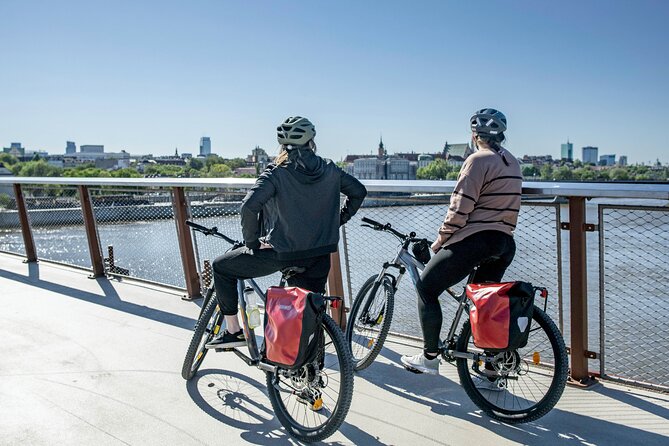
- Small group of up to 12 keeps the ride comfortable and lets the guide answer questions
- Kona bike setup plus helmet means less fuss and better peace of mind
- Neo-baroque, royal residences, and river ecology all in one loop
- Dedicated bike lanes under big bridges help you avoid the worst traffic stress
- Warsaw rebuilt after WWII is explained in the places where you can actually see the scars and the recovery
- Curie, Jewish Warsaw, and state memorials give the ride real meaning, not just scenery
How the 4-hour route makes Warsaw feel manageable
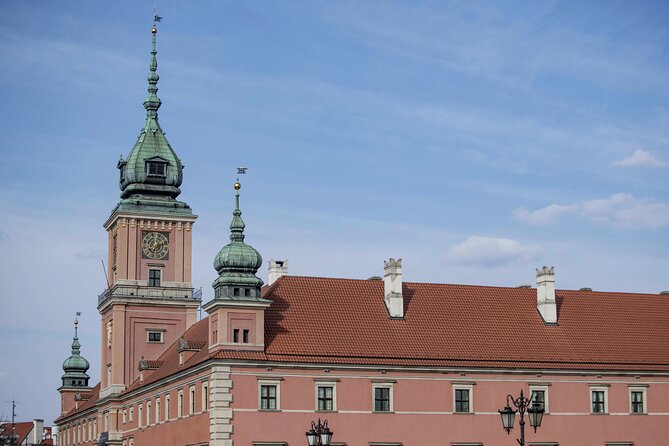
This tour works because it cuts Warsaw into bite-sized story chapters. In about four hours, you see major districts and landmarks that would take you much longer by bus or foot, especially once you factor in city traffic and detours.
The rhythm is smart: it starts with standout architecture, then moves into classic park sights, then shifts to the Vistula River corridor, and finally heads back toward the historic center. Along the way, you get short stops for viewpoints and explanations, so you do not have to choose between moving and learning.
If you like tours that are efficient but not robotic, this one hits the sweet spot. You are never stuck for long, but you also never feel like you are just being herded past things.
More Bike Tours in Warsaw
- 3-Hour Guided Cycling Tour of Warsaw
★ 4.9 · 624 reviews - Half-Day Warsaw City Sightseeing Bike Tour for Small Group
★ 5.0 · 240 reviews - Secrets of Warsaw 4-hour Bike Tour
★ 5.0 · 36 reviews
Meeting at Wspólna 65A, Kona bikes, and the comfort setup
You meet at Wspólna 65A (00-687 Warszawa) and the tour starts at 11:00 am. I suggest showing up about 15 minutes early, since you get a safety intro and time to get your bike sorted before the ride begins.
The ride quality matters here. You get a Kona bike rental, a helmet, and a waterproof side bag for your small items. That waterproof part is underrated in Warsaw, because weather can change fast and you do not want your phone or wallet trapped in a random pocket.
There is also locker luggage storage for the day of the tour until 16:30, which is handy if you are traveling light. And while coffee is not included, you do have a built-in café break later.
Finally, the tour is offered in English and is listed as “most travelers can participate,” so it is designed for typical visitors who can handle a steady ride.
Politechnika Warszawska to Jazdów: science, architecture, and first views
You begin with an introduction and then head to the main building of Politechnika Warszawska, a striking neo-baroque structure tied to Polish scientific progress for over a century. The key idea you take away is that this building survived the war era and still shaped generations of engineers and inventors. It is not just a pretty façade, it is a symbol of continuity.
From there, you cycle into Jazdów, crossing the area known for the Finnish Houses of Jazdow. The tour keeps it simple at this stage, with a quick explanation that helps you understand what you are looking at before you move on.
This is a good opening segment because it establishes the tour’s core theme: Warsaw is both modern and layered. You can see how the city keeps rebuilding while still carrying forward ideas about education, design, and public life.
Practical note: if you are new to biking in cities, the opening sets you up well since you start with clear landmarks and short transitions.
Jazdów to Łazienki Park: Ujazdowski Castle and the Palace on the Island
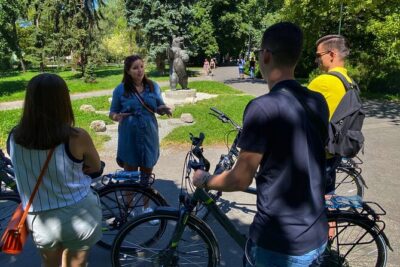
Next you reach Ujazdowski Castle, now home to the Centre for Contemporary Art. The interesting angle is the castle’s outlook: it gives you a sense of how the historic gardens and fountains are laid out, so you start noticing the park like a map rather than a blur.
Then you roll into Łazienki Park, one of Warsaw’s best-known green spaces. The highlight here is the stop at the epic lookout by the Palace on the Island. Even if you only get a few minutes, the viewpoint teaches you how the water and landscaping shape what feels royal and calm.
This part is also where the tour pacing tends to click. You are not stuck doing long guided lectures. Instead, you get a few minutes at each major stop, then you pedal again while your brain processes what you just learned.
If you are the type who likes parks but also wants context, this is a solid blend. You see the scenery, then you get the story that makes it stick.
Still in reach of Warsaw, but a different sort of day:
- Warsaw: Chopin Concert in the Old Town
★ 4.8 · 2,287 reviews - Warsaw: Traditional Galar Cruise on The Vistula River
★ 4.6 · 1,640 reviews - Warsaw: Old Town Highlights Walking Tour in English
★ 4.7 · 1,516 reviews - Warsaw Concert: Chopin – Painted by Candlelights with Wine
★ 4.8 · 1,442 reviews
Łazienkowski Bridge and Port Czerniakowski: from traffic to riverside calm
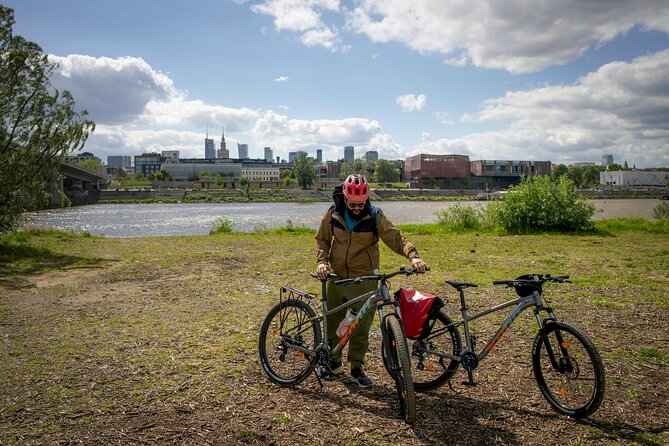
After the Łazienki Park section, the tour slows down in a practical way. You cycle safely under the busy Łazienkowski Bridge using a dedicated bike lane. This matters because it creates a real contrast: traffic noise and chaos above, quiet riverside riding below.
Right after that, you encounter Gruba Kaska, Warsaw’s water filtration point. It is one of those details that sounds technical, but it is exactly the sort of thing that makes a city feel real instead of postcard-flat.
The ride continues past the area considered the most dangerous beaches on the east river bank, even if the views are stunning. I like how the tour does not sugarcoat everything. You get the scenic payoff, along with the reality check.
You also get a 30-minute break at Port Czerniakowski, with time for a local café where you can buy a drink and refresh. This is a smart timing choice, because it happens after the most scenic part of the river corridor and before the next wave of bridges and monuments.
Plaża Poniatówka and Poniatowski Bridge: panoramic river views and the stadium story
Now the tour switches energy to wider city and river panoramas. You stop at Plaża Poniatówka, one of Warsaw’s popular urban beaches, where you get panoramic views and hear history about Warsaw’s bridges.
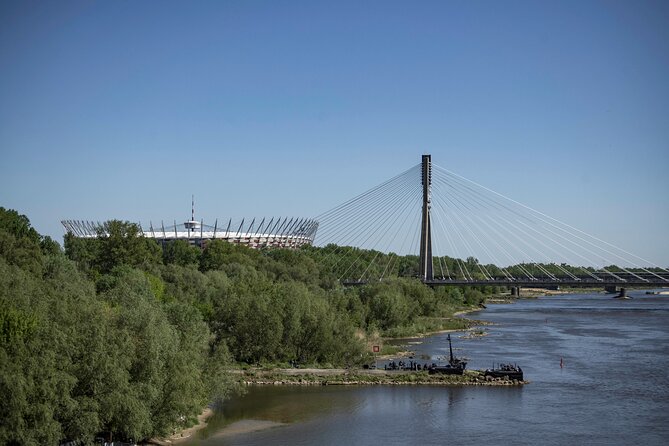
Then you pedal under the grand pillars of the historic Poniatowski Bridge. The guide ties it to Warsaw’s resilience and to the fact it is a key route for fans heading to the National Stadium.
The National Stadium stop adds another layer. It once hosted a bustling underground market before becoming the centerpiece for Euro 2012. That single contrast helps you understand how space in Warsaw can be repurposed, rebuilt, and re-imagined as the city’s needs change.
This section is great for photos, but also great for understanding scale. From the river, you start to see Warsaw as a set of connected corridors, not isolated sights.
Natura 2000 by bike, Stara Praga glimpses, and Vistula Boulevards
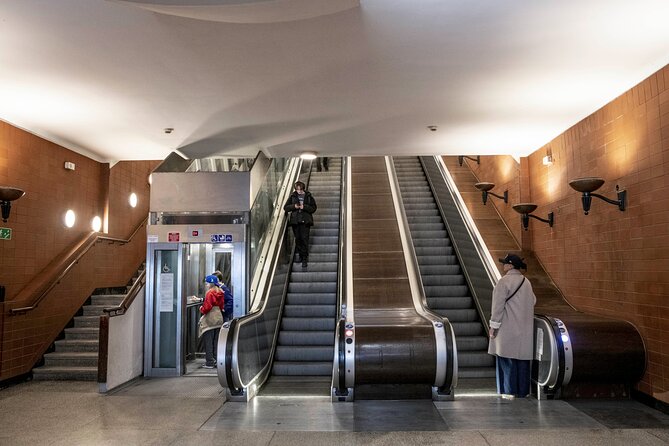
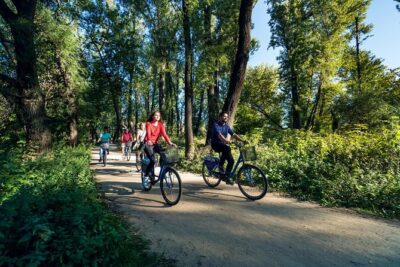
One of the most surprising moments is when the tour rides through a Natura 2000 area, a protected riverside haven for endangered species. You get an unexpected slice of wild nature right in the city center, which is exactly what makes Warsaw feel less generic.
Soon after, you get a glimpse of Stara Praga, where old Warsaw meets new. Even if your stop is brief, you feel the shift in character compared to the more formal areas near the center.
Then you ride along the Vistula Boulevards, the lively riverfront promenade that gives the city a human pace. You are not stuck in a museum circuit here. You are seeing Warsaw the way people experience it daily, with movement and views in constant rotation.
If you like the idea of mixing “wow” sights with practical city energy, this is the part that balances everything out.
Multimedia Fountain Park and Maria Skłodowska-Curie’s Warsaw
As you continue along the river corridor, you stop near Multimedia Fountain Park. The guide explains why the place is significant in the city’s origins. That angle is worth paying attention to, because it helps you understand why fountains are more than just decoration in some places.
Next comes the Monument to Maria Skłodowska-Curie. This is close to her childhood home, and you learn that she was the only woman to win two Nobel Prizes, born in Warsaw. It is a powerful moment because it ties global science to a specific neighborhood origin story.
I like monuments best when they do not feel like distant statues. Here, the location-based explanation helps you connect the idea of a great person to the city that shaped her early life.
Even if you only get about a couple minutes, the quick focus keeps it meaningful instead of turning it into a quick photo stop.
Nowe Miasto to Plac Zamkowy: Warsaw rebuilt after WWII
From the science-and-river stretch, the tour moves back into the story of rebuilding. You ride through Nowe Miasto, the quieter side of Old Town also called Warsaw New Town, rebuilt after WWII. The guide emphasizes that these streets survived fierce fighting and now blend centuries-old charm with everyday local life.
You also see the Warsaw Barbican, one of the few remaining pieces of the old defensive walls. This gives you a clear visual reminder that Warsaw used to be fortified, and the defensive geometry is still visible if you know where to look.
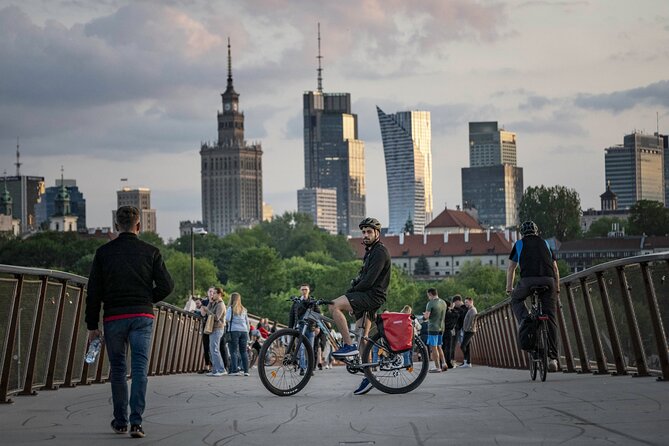
Then you arrive at Castle Square (Plac Zamkowy) for a short break. This is the center of gravity for a reason: the Royal Castle and Sigismund’s Column sit here, and you hear about how the area was rebuilt from ruins after WWII, earning UNESCO heritage status. The tour also mentions gems hiding in plain sight, and that is exactly how Castle Square feels if you slow down for a moment.
You get a strong payoff here before the ride turns toward politics, memory, and more street-level Warsaw.
The prestigious boulevard and the neoclassical palace where presidents work
After the stop, you cycle down one of Warsaw’s most prestigious streets. The vibe is noticeably different from the riverfront: historic buildings line the route, and there are luxury hotels plus some of the fanciest shopping.
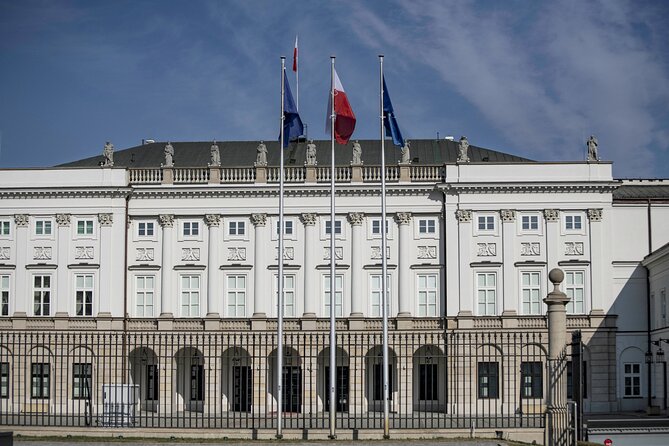
You also pass a neoclassical palace where Poland’s presidents work and live. Even without extra interior details, the guide frames it as a symbol of Polish statehood and modern politics.
This is an important contrast point. The earlier parts of the ride show parks and community spaces. Here you feel institutions, power, and government presence in the streetscape.
If you enjoy seeing how political identity shows up in everyday places, you will appreciate this segment. It is not just a ride-by, it is a quick orientation to how Warsaw represents itself.
Piłsudski Square, the Unknown Soldier, and the Jewish Warsaw streets
Next you reach Plac Marszałka Józefa Piłsudskiego, a stop tied to modern Warsaw memories, including the Pope’s visit and spy stories. The guide’s framing helps you see this as more than a monument plaza, it is where big events and big plots overlap.
You also pass Poland’s most important war memorial, guarded day and night, honoring all unknown soldiers who died fighting for the country. This part is solemn, but it fits the tour format because you get just enough context to understand why people treat it with care.
Then you ride through Warsaw’s oldest public park, a green oasis in the city center with fountains and old trees that locals favor for a break. It is a return to the “pedal and breathe” theme.
Finally, the tour enters the heart of Jewish Warsaw interpretation. You pass the only street from the Warsaw Ghetto that survived with original buildings, offering a rare look at pre-war Jewish Warsaw. After that, you stop at Plac Grzybowski, where you learn about the history of Jewish Warsaw and how that culture helped shape the city you see today.
This is emotionally heavier material, but the structure makes it manageable. You get quick, clear explanations while you are still moving, not stuck in a long timeline slog.
Palace of Culture and Science: a controversial giant up close
The ride ends with the Palace of Culture and Science, Warsaw’s tallest and most controversial building. The guide calls out its Stalin-era origins as a gift from Stalin, then shares some secrets about what is inside.
Even if you do not go into the building here, the tour gives you a better way to look at it. Instead of seeing it as just a massive concrete landmark, you learn why it is controversial and why people still discuss it.
It is a good photo moment, and it also closes the loop thematically. Earlier you saw Warsaw’s architecture from a scientific and royal angle, and now you see the Soviet-era imprint that still dominates the skyline.
Then you finish back at the bike point in downtown Warsaw, with the whole circuit feeling like one connected story rather than ten separate stops.
Should you book this Warsaw Nature and Urban Highlights bike tour?
If you want a high-value, low-stress way to cover Warsaw in four hours, I think you should book it. The combination of Kona bike comfort, helmet and safety briefing, a group size of up to 12, and a route that mixes parks, riverfront, and major landmarks is a strong formula.
I would especially recommend it if:
- you like city sightseeing but dislike the fatigue of constant walking
- you want real context at landmarks, not just names and dates
- you value safety, since the ride uses dedicated bike lanes in key spots
Skip it only if weather is likely to be rough, because this tour requires good conditions. Also, if you have very limited comfort riding a bike for a half-day, plan for a slower personal pace during stops and bring the mindset that you will still be riding steadily between scenes.
FAQ
How long is the Warsaw bike tour, and what time does it start?
The tour lasts about 4 hours and starts at 11:00 am.
Where is the meeting point, and does the tour end there too?
You start at Wspólna 65A, 00-687 Warszawa. The tour ends back at the same meeting point.
What is included in the price, and what is not?
Included are bicycle rental (Kona), a helmet, a waterproof side bag, and locker luggage storage until 16:30. Coffee and tea are not included.
Is the tour offered in English, and what is the group size?
Yes, it is offered in English. The maximum group size is 12 travelers.
Is this bike tour suitable for most people, and how does it handle safety?
It is described as suitable for most travelers. You get a safety brief at the start, helmets are provided, and you ride on designated bike lanes for key sections like under Łazienkowski Bridge.
What if the weather is poor, or I need to cancel?
The experience requires good weather. If it is canceled due to poor weather, you will be offered a different date or a full refund. You can cancel up to 24 hours in advance for a full refund.
Fresh listings from Warsaw
- Wolf’s Lair & Treblinka Tour in 1 day from Warsaw★ 5.0 · 37 reviews
- Tour from Warsaw: Wolf’s Lair, Hitler’s HQ Zones I and II★ 5.0 · 32 reviews
- Wolf’s Lair Private Day Trip from Warsaw★ 5.0 · 50 reviews
- Warsaw’s Old Town A Self-Guided Audio Tour★ 4.5 · 10 reviews
- Wilanow Royal Palace : SMALL GROUP /inc. Pick-up/★ 4.5 · 16 reviews
- Warsaw Must-See Local City Tour with Antek and Tomek★ 5.0 · 51 reviews
- Private 3-, 5-, or 7-Hour Warsaw Tour by Car★ 5.0 · 7 reviews
- Off the Beaten Track in Warsaw: Private City Tour★ 4.5 · 9 reviews
Cycling Tours, compared.
Complete Cracow Bike Tour (small group of maximum 15 people!)
Read our review →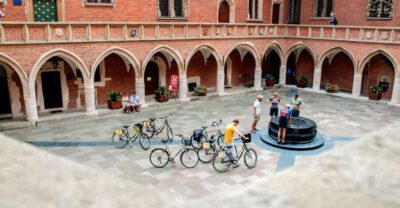
Bike Tour of Old Town, Jewish Quarter and the Ghetto
Read our review →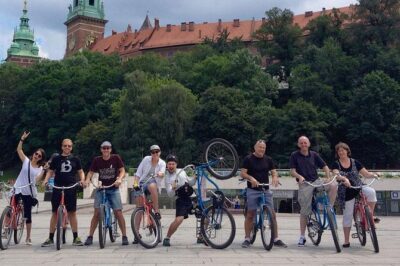
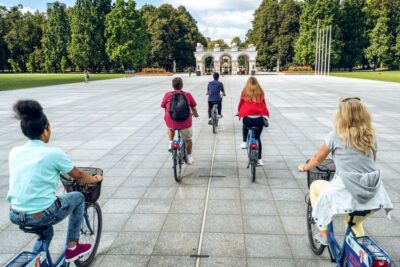
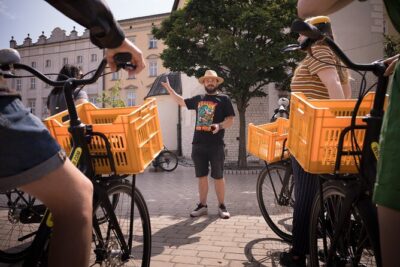
Full Bike Tour – the Old Town, Jewish Qtr & the Ghetto NEW BIKES
Read our review →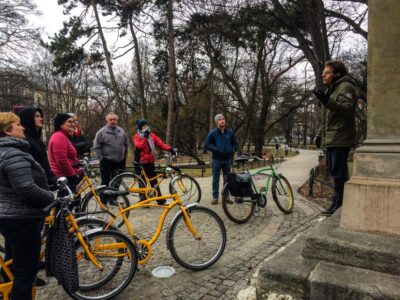
Half-Day Warsaw City Sightseeing Bike Tour for Small Group
Read our review →Browse the lists this tour appears in