
Review · CITY TOURS
Warsaw City Tour – PRIVATE (4h)
Warsaw is a city that keeps rebuilding. In this private 4-hour tour, you get a tightly planned taste of Old Town, memorials, and palace parks, guided end to end. I especially love the way you go from iconic symbols like Kolumna Zygmunta to the rebuilt streets of UNESCO Old Town, and then onto the calm of Lazienki Park. The one thing to think about is the mix of walking and vehicle time, since parts of the route have traffic restrictions.
You will also feel the difference a good guide makes. Names that popped up in feedback include Grazyna, Karolina, Margarita, and Anya, and that lines up with why this tour works best when your guide adjusts the pace and focus. Plan comfy shoes, and if heat or mobility is an issue for anyone in your group, tell the operator ahead of time.
In This Review
- Quick hits before you go
- A 4-hour private Warsaw loop, and what to expect
- Price and logistics: private means you choose the pace
- King Sigismund’s Column: Warsaw’s symbol with a complicated past
- Old Town UNESCO: the trade route that shaped the streets
- Royal Castle: why it was rebuilt so faithfully
- St. John’s Archcathedral: organ concerts and the May 3 oath
- Rynek Starego Miasta and the Warsaw Mermaid moment
- Barbican Warszawski: the defensive wall you can still walk around
- Warsaw Uprising Monument to Miodowa Street: protest, power, and faith
- Theatre Square and the Grand Theatre, reconstructed memory in stone
- Tomb of the Unknown Soldier: a noon moment you can plan for
- Royal Route to Lazienki: from power corridors to garden calm
- Lazienki Krolewskie: Chopin’s summer piano tradition and a real pause
- Palace of Culture and Science, National Stadium, Copernicus: big city energy
- Who this tour suits best, and how to avoid the common traps
- Should you book Warsaw City Tour – PRIVATE (4h)?
- FAQ
- How long is the Warsaw City Tour – PRIVATE?
- Is this tour private?
- Does the tour include hotel pickup and drop-off?
- Is an air-conditioned vehicle included?
- What language is the tour offered in?
- Is a mobile ticket provided?
- Are admission fees included?
- Does the tour include Copernicus Science Centre admission?
- Is free cancellation available?
- Do we need to pay for every stop?
Quick hits before you go
- Old Town UNESCO plus the rebuilt story, not just a photo stop
- Lazienki Park break time, with the famous Chopin piano tradition mentioned as part of the experience
- Air-conditioned private transport is included, but some segments may be more walk-heavy due to access limits
- Tomb of the Unknown Soldier with the noon guard change you can plan around
- St. John’s Cathedral with seasonal organ concerts and major historical ties
- Copernicus Science Centre is modern, fun, and the admission is not included
A 4-hour private Warsaw loop, and what to expect
This is a classic half-day shape: you start in the historic core, hit the key monuments and squares, then shift into parks and major landmarks. The promise is a focused tour of highlights, not a slow, rambling day of “maybe we’ll see that.” With hotel pickup and drop-off, the big advantage is you lose less time to figuring out transport.
Because it is private, your guide can tune the tempo. If you want more stop time for photos or a quieter pace for resting, you can usually steer it that way. The schedule includes short stays at many places, so you should think of it as a guided highlights playlist, with enough context to make it stick.
A few more Warsaw outings to weigh up
- Warsaw: Chopin Concert in the Old Town
★ 4.8 · 2,287 reviews - Warsaw: Traditional Galar Cruise on The Vistula River
★ 4.6 · 1,640 reviews - Warsaw: Old Town Highlights Walking Tour in English
★ 4.7 · 1,516 reviews
Price and logistics: private means you choose the pace
At $195.18 per person for a private 4-hour tour, the value comes from the combination of a professional local guide plus pickup and drop-off. You are paying for convenience and interpretation, not just movement between sites. If you have limited time in Warsaw, private is often the fastest way to cover a lot without losing your nerve to transit.
One practical caution: the tour is designed for both driving and walking, and access rules can affect how much car time you get. In a couple of experiences, guests pointed out mismatches around vehicle use outside the Old Town area and walking expectations. My advice is simple: confirm when the air-conditioned vehicle will be used versus when you will be on foot, especially if you care about comfort in hot weather.
King Sigismund’s Column: Warsaw’s symbol with a complicated past
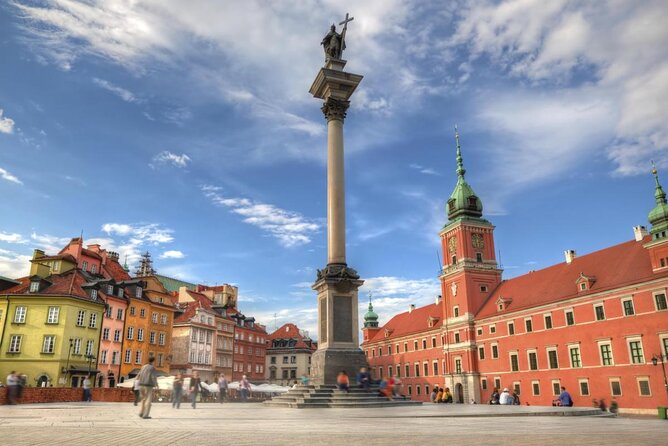
You begin at King Sigismund’s Column (Kolumna Zygmunta), one of the city’s oldest public memorials. It is also a great “how Warsaw survived” lesson, because the column did not stay in one place for long. The axis of Krakowskie Przedmieście Street changed in the 19th century, and after World War II the column was moved again during construction of the WZ route.
The story here is heavy, but you get the key dates without getting lost in details. You learn that in 1944 German troops brought the column down, and reconstruction finished by 1949. It is a perfect opening stop because it sets the theme of the entire day: symbols, destruction, rebuilding, and identity.
Old Town UNESCO: the trade route that shaped the streets
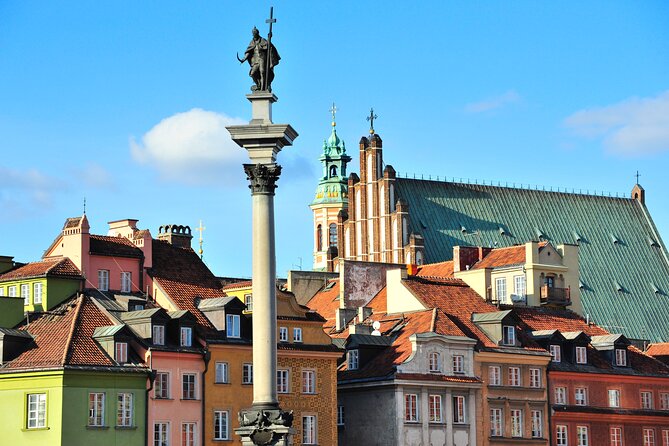
Next comes Old Town, built on a river-adjacent trade location between the Baltic Sea and the Black Sea. That means the city’s rise was not random. Wealthy tradesmen and craftspeople settled here, and the urban pattern grew fast.
You also get a clear, readable timeline of what you are looking at. Wooden buildings were replaced by masonry after fires, and ramparts shifted from earthen to stone walls. Then comes the blunt fact of 1944, when around 90 percent of the Old Town was destroyed. The reconstruction took years and ended with Old Town earning UNESCO World Heritage status, so the rebuilt layout is not just “pretty,” it is a documented recovery effort.
Still in reach of Warsaw, but a different sort of day:
- Warsaw Concert: Chopin – Painted by Candlelights with Wine
★ 4.8 · 1,442 reviews - Warsaw: City Sightseeing Hop-On Hop-Off Bus Tour
★ 3.6 · 1,415 reviews - Warsaw: Highline Warsaw Entry With 360° Views & Rooftop Bar
★ 4.4 · 1,297 reviews - Warsaw: POLIN Museum of the History of Polish Jews Ticket
★ 4.7 · 1,142 reviews
Royal Castle: why it was rebuilt so faithfully
The Royal Castle stop adds the next layer of Warsaw’s resilience. The castle became a royal residence after the Masovia region joined the Crown in the 16th century. It was repeatedly destroyed and rebuilt over time, including the Deluge and later upheavals.
World War II is the breaking point for most visitors. The castle was bombed early in the conflict, set on fire, and left nearly destroyed. Valuable art was saved because it was taken out in time and hidden, but remaining works were plundered and in 1944 the castle was blown up in retaliation for the Warsaw Uprising. The reconstruction decision came much later, in 1971, and the site reopened in 1984. This is one of the reasons the castle later earned UNESCO status as a faithful reconstruction.
St. John’s Archcathedral: organ concerts and the May 3 oath
You then head to the Archcathedral Basilica of St. John the Baptist, one of Warsaw’s oldest churches. It is historically packed without feeling like a museum lecture. If your timing fits, the church hosts concerts: every Sunday at 4 PM from July to September as part of the International Organ Music Festival.
This stop also connects you to major civic history. The church is tied to the Constitution of May 3 oath, described as the first of its kind in Europe. Under the church, the crypt holds tombs of historical figures, including the Chapel-Mausoleum of the Primate of the Millennium. Even with a short visit, it gives you a sense of Warsaw as both political and spiritual.
Rynek Starego Miasta and the Warsaw Mermaid moment
At the Old Town Marketplace (Rynek Starego Miasta), you get the square that anchors the area: tenement buildings around you, plus restaurants, cafes, galleries, and museums. It is easy to treat this like a hangout zone, but the tour nudges you to see what the square represents.
A highlight here is the Warsaw Mermaid statue, which has become a key symbol of the city. The marketplace sections are also linked to enlightenment-era activists, named as Kołłątaj, Dekert, Barss, and Zakrzewski. It is a small detail, but it helps you read the city like a map of ideas, not only an arrangement of landmarks.
Barbican Warszawski: the defensive wall you can still walk around
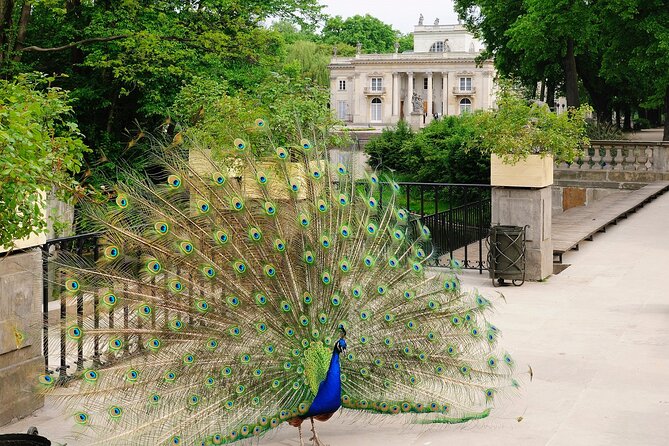
The Warsaw Barbican (Barbakan Warszawski) is built in 1548 as part of defensive walls described as around 4,000 feet in length. Today, it is not just stone. It is a working-feeling place for painters and musicians, and the tour uses that contrast to help you imagine the city before the war destruction.
From May to October, there can be exhibitions inside featuring historical photos and models of defensive lines and towers that no longer exist. Even if you skip the inside part, comparing those old images in your mind to the Old Town shape helps you understand how the defenses protected the heart of Warsaw. The “what if” effect is real, and it makes the later memorial stops hit harder.
Warsaw Uprising Monument to Miodowa Street: protest, power, and faith
The day turns solemn with the Warsaw Uprising Monument, depicting insurgents in battle. The uprising ended in defeat with the death of about 200,000 Poles, making it one of the most painful moments in the modern history of Poland and Warsaw. If your group prefers lighter pacing, this is still worth doing, but know it sets a tone.
From there, you move into the nearby palace-and-institutions area tied to Krasiński Palace (also called the Palace of the Republic). It is described as an enchanting Baroque structure, with reliefs inspired by antique works, and it currently hosts special collections for the National Library. The park behind the palace is flagged as a good place to relax briefly, and the tour also points out the Supreme Court seat nearby.
Then you continue toward Miodowa Street, a narrow lane with ancient residences. This is one of those “slow down and look up” segments. The info highlights specific buildings: the Collegium Nobilium at number 24, the Primate of Poland’s residence at number 17, Warsaw’s only Eastern Catholic Church at number 16, and the Church of the Capuchins. The Capuchins stop includes a detail that the right side of its altar features the heart of Jan III Sobieski. The area also connects to the Monument of Warsaw’s Heroes, often called the Monument of Nike.
Theatre Square and the Grand Theatre, reconstructed memory in stone
At Theatre Square, you see the Late Baroque Blank Palace and, behind it, Jabłonowski Palace. The city hall role and the WWII destruction are part of the story, and the rebuild in the 1990s is explained as keeping only the façade and clock tower from the original design. If you have time, walking through the gate under the tower lets you see foundations laid in the 19th century.
The Grand Theatre comes next, a large Classicist building facing Jabłonowski Palace. It houses the National Opera and National Theatre. The tour context here helps, since the opera stage is described as one of the largest in Europe, and the interiors feature cut glass chandeliers, a spacious foyer with columns, and floor tiling you will notice even in passing. If you do not attend a performance, you can still appreciate the exterior rhythm and the scale.
The stop also mentions the Petrykus Tenement House from 1821, now filled with restaurants and clubs, something locals value as part of the square’s daily life.
Tomb of the Unknown Soldier: a noon moment you can plan for
The Tomb of the Unknown Soldier is one of Warsaw’s most meaningful stops. It commemorates the millions of soldiers who sacrificed their lives for Poland’s freedom. It is described as housing ashes from a defender of Lvov plus an urn with soil from World War I battlefields, and the tomb includes urns from every battlefield where Polish troops fell in the last century.
There is an eternal flame maintained next to the tomb, and a military honor guard. The key detail for planning is that the guard changes daily at noon. Even if you are not there right at noon, the presence of the flame and the ritual feel adds weight to the earlier uprising and memorial material, without becoming a repetitive lecture.
Royal Route to Lazienki: from power corridors to garden calm
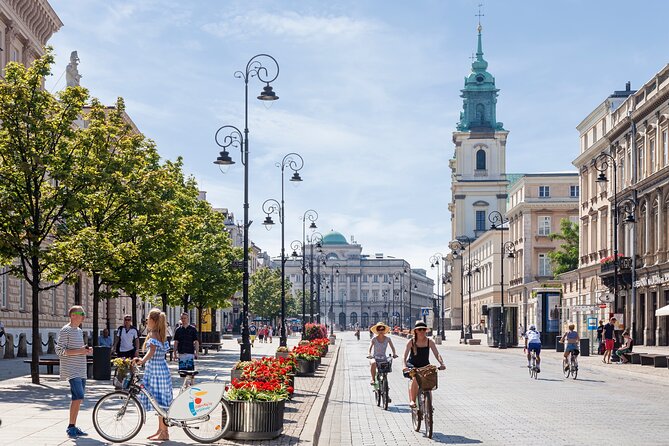
The tour then shifts into the Royal Route, described as stretching from Zamkowy Square to Trzech Krzyży Square. This is where you get a sense of the city’s grand “corridor of power” style, with religious, educational, and political buildings along the way.
Stops mentioned for the route include St. Anne’s Church and the view from its tower, plus the Polonia House, where Maria Skłodowska-Curie worked when it functioned as the Museum of Industry and Trade. You also see the Radziwiłł Palace, described as the current residence of the President of Poland. On the educational side, the Warsaw University campus with Kazimierzowski Palace and the Czapski Palace for the Academy of Fine Arts appear in the route list. The tour also highlights elegant shops and restaurants on Nowy Świat Street, as an extension of Krakowskie Przedmieście Street.
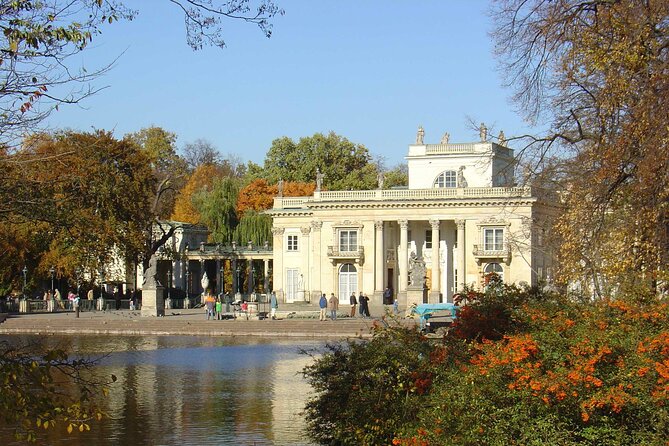
Then you reach the relief point: Lazienki Krolewskie in Royal Łazienki Park. You get a proper walking break here, with a museum and events space as well as gardens.
Lazienki Krolewskie: Chopin’s summer piano tradition and a real pause
Lazienki Royal Park is described as one of the most beautiful palace and garden complexes in Europe, with a mix of palace structures and a park in a formerly wild forest. It is also a place for cultural, scientific, and entertainment events, so it does not feel like a dead park.
A very specific detail to look for is the free piano concerts held for 50 years on summer weekends next to the famous monument of F. Chopin. The tour notes crowds of tourists and local classical music lovers during those times. Even outside concert periods, you still get the garden logic: long sightlines, relaxed pacing, and the kind of atmosphere that makes the morning’s memorial stops feel less heavy.
The stop timing is set at about 30 minutes, which is enough for a short stroll and a breather, as long as you do not try to do everything at once.
Palace of Culture and Science, National Stadium, Copernicus: big city energy
After Lazienki, you move toward some of Warsaw’s more modern, large-scale symbols.
First is the Palace of Culture and Science, built between 1952 and 1955 as a gift from the Soviet people to Poland. It is the tallest building in the country at 230.5 m, and the key attraction mentioned is the large observation deck on the 30th floor. The tour describes it as having a huge number of rooms, plus offices and institutions, and even amenities like a post office, cinema, swimming pool, museums, libraries, theatres, a cafe, and clubs. Whether you ride up or just admire it, it is a stark contrast to Old Town stone.
Then you get the National Stadium, described as the modern, largest venue built for the European Football Championship in 2012. It is on the site of the historic Tenth Anniversary Stadium, which hosted major sporting events and propaganda rallies in the years after the mid-1950s. For sport fans, it is a simple way to connect Warsaw’s past public life to what you see today.
Finally comes the Copernicus Science Centre, opened in November 2010 and framed as one of the most modern science centers in Europe. The focus is hands-on curiosity, with hundreds of attractions listed like an earthquake simulator and a magic carpet. There is also a roof garden with observation decks and nearby extras like an art gallery, a climbing wall, and a park with art exhibits. Admission is not included for this stop, so treat it as an optional payoff if your group wants more than sightseeing.
Who this tour suits best, and how to avoid the common traps
This works best if you want a guided map of Warsaw that includes both the big memorial story and the beauty of the city’s rebuilt center. It is also a strong choice for first-timers who have a limited time window and want to see Old Town, the Royal Route, and Lazienki without planning each segment.
It can be less ideal if you dislike walking at all, since you will be on foot for several pieces of the route, and hot weather can change the experience fast. One review mentioned one guest had a disability and the walking load was not possible for the full program. If you have mobility needs, tell the operator in advance and ask for a modified pace.
Also, pay attention to vehicle expectations. The tour includes air-conditioned private transportation, but car access can vary due to restricted areas like UNESCO zones and pedestrian corridors. Your best move is to ask your guide, on the day, where the vehicle will be used and where you should expect walking.
Should you book Warsaw City Tour – PRIVATE (4h)?
Book it if you want a smart first look at Warsaw in half a day, with a local guide who can connect monuments to the stories behind them. The Old Town UNESCO portion, the Royal Castle reconstruction context, and the contrast of Lazienki Park give you variety without chaos.
Skip or choose carefully if you need lots of seated time, or if you cannot do walking segments in heat. Also, if you care about AC in every transfer outside the Old Town, confirm that up front so there are no surprises about where the car can and cannot go.
If you do book, my practical tip is to travel with a short list of what matters most to you, like either memorials, architecture, or parks, and tell your guide early. In a private tour, those preferences can shape the whole day.
FAQ
How long is the Warsaw City Tour – PRIVATE?
The tour lasts about 4 hours.
Is this tour private?
Yes. It is a private tour/activity, so only your group participates.
Does the tour include hotel pickup and drop-off?
Yes, hotel pick-up and drop-off are included.
Is an air-conditioned vehicle included?
The experience includes private transportation and an air-conditioned vehicle.
What language is the tour offered in?
The tour is offered in English.
Is a mobile ticket provided?
Yes, a mobile ticket is included.
Are admission fees included?
Entry or admission fees are not included (they are listed as optional). Some stops in the itinerary are marked as free.
Does the tour include Copernicus Science Centre admission?
No. Copernicus Science Centre admission is not included.
Is free cancellation available?
Yes, you can cancel for a full refund up to 24 hours in advance.
Do we need to pay for every stop?
Not every stop requires payment. Several stops in the itinerary list free admission, but it depends on which sites you choose to enter (when applicable).
Fresh listings from Warsaw
- Wolf’s Lair & Treblinka Tour in 1 day from Warsaw★ 5.0 · 37 reviews
- Tour from Warsaw: Wolf’s Lair, Hitler’s HQ Zones I and II★ 5.0 · 32 reviews
- Wolf’s Lair Private Day Trip from Warsaw★ 5.0 · 50 reviews
- Warsaw’s Old Town A Self-Guided Audio Tour★ 4.5 · 10 reviews
- Wilanow Royal Palace : SMALL GROUP /inc. Pick-up/★ 4.5 · 16 reviews
- Off the Beaten Track in Warsaw: Private City Tour★ 4.5 · 9 reviews
- Warsaw Must-See Local City Tour with Antek and Tomek★ 5.0 · 51 reviews
- Private 3-, 5-, or 7-Hour Warsaw Tour by Car★ 5.0 · 7 reviews
City Tours, compared.
City Sightseeing Tour Eco Electric Buggy Golf Cart
Read our review →
Gdańsk City Sights & History Guided Walking Tour in English
Read our review →
Extended City Sightseeing Tour – Eco Buggy Golf Cart
Read our review →
Shared or Private City Tour Sightseeing by Golf Cart
Read our review →Browse the lists this tour appears in