
Review · WARSAW TOURS
Warsaw for WWII Buffs – private tour with hotel pickup
Warsaw hits hard, and this tour explains why. In about three hours, you ride a retro Żuk minibus and get central hotel pickup, which means less fuss and more time learning the WWII story where it happened. I especially like the fast, comfortable way the transport links multiple key sites, and I like the private format that lets the guide steer the pacing. One drawback to plan for, the vintage vehicles do not have air-conditioning, so warm days can feel stuffy.
You’ll also get a clear narrative, from the late-1930s political climate to the ghetto’s physical division of the city, then to the uprising and its aftermath. This is the kind of tour where the history feels local, not like a textbook. And yes, it’s intense, so wear comfortable shoes and bring a little emotional patience.
In This Review
- Key highlights you will actually feel during the tour
- A retro Żuk ride through Warsaw’s darkest streets
- Hotel pickup within 3 km keeps your day on schedule
- Stop-by-stop: from 1939 invasion and Soviet occupation to Warsaw resistance
- Waliców and the ghetto wall fragments you can still spot
- Chłodna Street bridge and the strange logic of a divided city
- Muranów, the Monument to the Ghetto Heroes, and the POLIN area
- From the Monument in the East to the Warsaw Uprising Monument
- Comfort and pacing tips for a 3-hour WWII reality check
- Price and value: what $169.38 buys you in a private story
- Who should book, and who should plan differently
- Should you book Warsaw for WWII Buffs?
- FAQ
- What is included in the Warsaw for WWII Buffs private tour?
- Is this tour private?
- How long is the tour, and do you walk much?
- Are admission tickets required for the stops?
- Is the vehicle comfortable, and does it have air-conditioning?
- Can the tour be customized to my interests?
- How does hotel pickup work if my hotel is outside the 3 km radius?
- What is the cancellation policy?
Key highlights you will actually feel during the tour
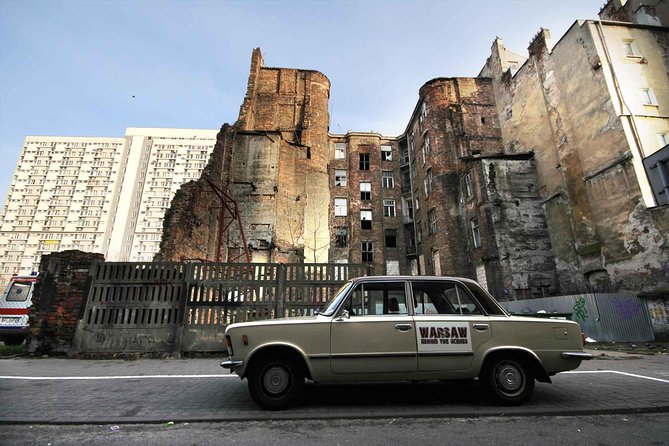
- Retro Żuk transport makes getting between sites part of the experience, not just a transfer
- Hotel pickup within 3 km cuts time, especially if you want to fit this into a busy day
- A private, English-speaking guide can tailor the story to what you care about
- Visible ghetto remnants let you understand boundaries you can still trace today
- Memorial stops across WWII and the postwar Soviet period show how the story kept unfolding
- Most stops have free admission, so your budget goes mostly to the tour itself
A retro Żuk ride through Warsaw’s darkest streets
The big “wow” here is the transport. The tour uses a retro communist-era Żuk minibus for moving through Warsaw, and it changes your whole feel of the day. You are sitting in something historic, bumping along city streets, while your guide stitches together what you are seeing with what happened in those blocks decades ago.
That said, this is not a modern, climate-controlled bus experience. The vehicles have heating for winter, but they do not have air-conditioning, and some do not have seat belts because they are historic vehicles. If that kind of comfort factor matters to you, dress smart, plan for less-than-smooth roads, and bring a layer in case the heating or temperature swings.
I also appreciate that the tour uses the vehicle mainly between stops. You get repeated chances to walk, look up at buildings and street lines, and notice the quiet physical clues the city still keeps. That is the difference between hearing a story and recognizing the setting.
Finally, the private format matters here too. With only your group, the guide can slow down when something hits, or speed up when you want to keep the day moving.
A few more Warsaw outings to weigh up
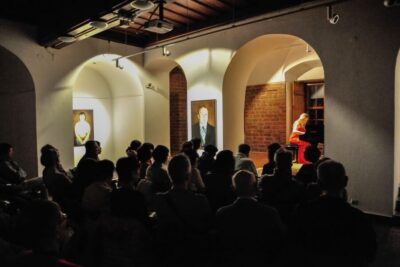
- Warsaw: Chopin Concert in the Old Town
★ 4.8 · 2,287 reviews - Warsaw: Traditional Galar Cruise on The Vistula River
★ 4.6 · 1,640 reviews - Warsaw: Old Town Highlights Walking Tour in English
★ 4.7 · 1,516 reviews
Hotel pickup within 3 km keeps your day on schedule
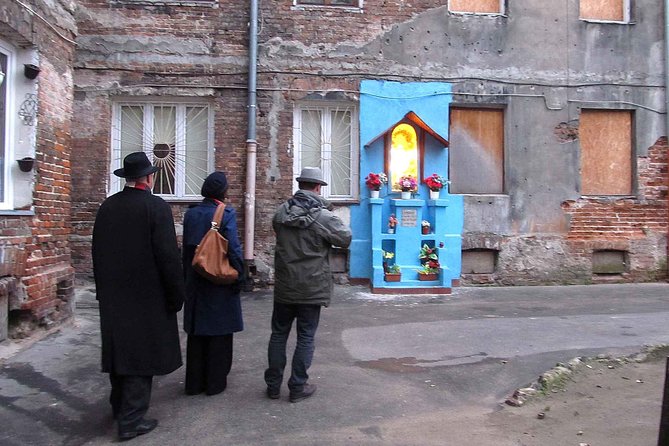
This is a private tour with pickup and drop-off within a 3 km radius of the city center. That sounds simple, but it changes real-world logistics. Instead of spending your time figuring out buses or meeting points, you start from your hotel or apartment and stay in a smoother flow.
There is one timing twist worth knowing: transfer time counts toward the total tour time. In practice, that means if your accommodation is far from the center, you may lose some time that could have gone into the walking stops. The operator notes that if pickup is farther or hard to reach by car, they suggest the closest convenient meeting point. If you want to maximize sightseeing inside the scheduled window, meeting the guide closer to the center can be a smarter move.
Your vehicle will carry up to 8 passengers, and there is a fleet available, so you are not crammed into a huge group bus. Also, this is run as a private activity, meaning only your group participates.
All of this is why the tour works for a busy itinerary. Three hours can sound tight for something emotional and historical, but the setup is designed to keep momentum.
Stop-by-stop: from 1939 invasion and Soviet occupation to Warsaw resistance
The tour begins in central Warsaw with a wide historical frame. Your guide sets up the political climate of the late 1930s, then moves into the German invasion of Poland in 1939. Just as important, they also cover the simultaneous Soviet occupation of eastern Poland, because Warsaw’s experience did not unfold in isolation. The war, the occupations, and the shifting control all shaped everyday life, and they shaped the emergence of resistance.
From there, the story becomes more personal and darker, as it turns toward the ghetto system and the city’s enforced division. You do not just get dates. You get explanations of how policies translated into streets, walls, and daily movement.
The way the guide structures it tends to land well for different levels of experience. If you are a WWII devotee, the narrative connects the dots between major events. If you are newer to the subject, you get the context you need without feeling like you are missing pages.
And because it is a private tour, you can ask questions as you go. Several guides have a conversational teaching style in the way they handle Q&A, and that matters when topics can get complicated fast. You are not stuck waiting until the end.
Waliców and the ghetto wall fragments you can still spot
One of the most powerful parts of the route is the focus on what remains. The tour brings you into the story of the Jewish population persecuted and murdered by Nazi Germany. Before the war, Poland had around three million Jews, including roughly 300,000 in Warsaw. In 1940, the Nazis established the Warsaw Ghetto and forcibly confined nearly half a million people inside.
What makes the stop work today is that you are not only told about boundaries. You see surviving fragments of the ghetto wall hidden between buildings and along older property lines. Your guide takes you to a preserved section, helping you understand how the ghetto boundary once divided the city, and how that division shaped daily life under occupation.
Then you move to Waliców again, this time with a special emphasis on the physical wreckage. The Waliców tenement house is described as a lasting ruin from the ghetto era, and the area includes a preserved fragment of ghetto wall. It is a rare kind of sight, because it does not feel like a reconstructed set. It feels like a scar still visible in the urban fabric.
Walking these segments is short, but the effect can be big. This tour does not treat the ghetto story as a distant historical topic. It frames the city as a living reminder.
Still in reach of Warsaw, but a different sort of day:
- Warsaw Concert: Chopin – Painted by Candlelights with Wine
★ 4.8 · 1,442 reviews - Warsaw: City Sightseeing Hop-On Hop-Off Bus Tour
★ 3.6 · 1,415 reviews - Warsaw: Highline Warsaw Entry With 360° Views & Rooftop Bar
★ 4.4 · 1,297 reviews - Warsaw: POLIN Museum of the History of Polish Jews Ticket
★ 4.7 · 1,142 reviews
Chłodna Street bridge and the strange logic of a divided city
A key stop focuses on Chłodna Street and how it physically split the ghetto into two parts. Chłodna Street served for East-West transfer traffic, which sounds technical until you realize what that meant on the ground.
Near the intersection of Chłodna and Żelazna streets, a wooden bridge was built to link the two parts of the ghetto. The details are chilling: the bridge reached up to the third floor of nearby buildings, allowing what were described as Aryan trams, German military transports, and cars to pass beneath it. In photographs, you can see how the city’s infrastructure worked around the ghetto boundary.
Your guide uses these details to make the abstract reality concrete. You start to notice street alignment, building heights, and how movement was managed and restricted. Even if you have read about ghettos before, this kind of street-level explanation changes how the story sticks in your mind.
It is one of those stops where you leave understanding not just what happened, but how it was organized.
Muranów, the Monument to the Ghetto Heroes, and the POLIN area
Next comes Muranów. At first glance, it can look like a normal residential neighborhood made of flat blocks. Your guide’s job is to teach you how not to judge by appearance. There is more from the past to discover here than you would guess without local context.
From Muranów, the tour includes an area visit connected to two key symbolic sites: the Monument to the Ghetto Heroes and the POLIN Museum of the History of Polish Jews. They are located near where the first armed clashes of the 1943 Ghetto Uprising occurred.
This is also where the tour shifts from tragedy to meaning. The guide frames the location as a place of decades of remembrance and reconciliation among Polish, Jewish, and German communities. That does not erase the suffering, but it gives the story a human ending point, one that goes beyond survival.
If you are planning your day, this is a good time to slow down mentally. The stops here can feel moving in a quiet way, not a dramatic one. You stand in the space, and the guide connects it back to what those clashes meant.
From the Monument in the East to the Warsaw Uprising Monument
The next chapter moves outward to the Soviet occupation. On September 17, 1939, two weeks after the outbreak of WWII in Europe, Poland was attacked by the Soviet Union and the eastern part of the country was lost forever. The tour includes the Monument to the Fallen and Murdered in the East, erected to honor Poles deported to Gulags in Siberia, killed in executions, and victims of the Katyń massacres.
This stop matters because it broadens WWII beyond the German occupation narrative that many visitors know first. It also helps explain why WWII memory in Poland can feel layered, not single-track. You are seeing the way one conflict shifted into another form of suffering under a different occupying power.
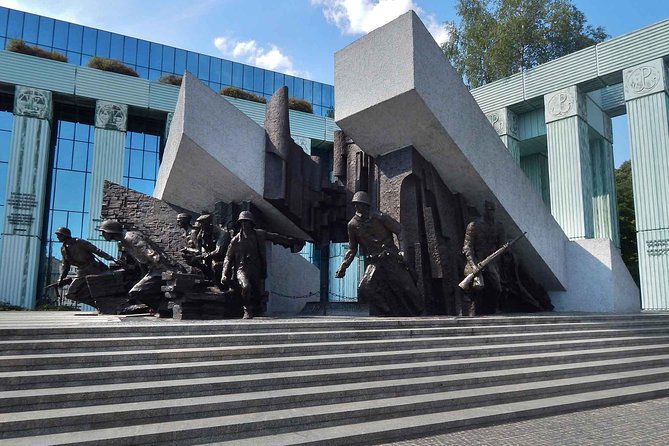
The final stop is the Warsaw Uprising Monument, focused on 1944, the city’s last attempt to regain independence before the Red Army arrived. After the uprising failed, Nazi forces systematically destroyed most of Warsaw. The Soviet army entered the empty ruins in January 1945, starting a new era of communist rule.
That closing arc is why the tour works as a complete experience in only three hours. You are not left with just one painful episode. You see how events chained together, and how the city’s reconstruction and politics followed.
Comfort and pacing tips for a 3-hour WWII reality check
This tour is short, but it is not a light stroll. You will have walking segments at each stop, and you will likely spend extra time looking carefully at walls, street lines, and memorial spaces. Wear comfortable clothing and suitable footwear. If your shoes are borderline, you will feel it after the second stop.
Temperature matters too. The vehicles have heating for winter, but no air-conditioning. On a hot day, plan for less airflow. On a cold day, expect warmth in the vehicle, then cooler outdoor walking.
Seating comfort is a mixed bag. The vehicle is historic, and some minibuses may not have seat belts. Also, at least one account notes that the vehicle provided can differ from what people expect from the description, and that getting in and out may be awkward for a smaller, older traveler. If you are traveling with mobility needs or you just hate cramped seating, contact the operator in advance and ask which exact vintage vehicle you will use.
One more practical tip: since the history is intense, take it in small mental bites. The guide will likely check in on comfort and questions, but you should also pace yourself. This is the kind of tour where a few reflective pauses help.
Price and value: what $169.38 buys you in a private story
At $169.38 per person for about 3 hours, you are paying for more than a ride and a few landmarks. You are paying for a private English-speaking local guide and for transport by the retro minibus, plus hotel or apartment pickup and drop-off within 3 km of the city center.
You also get admission listed as free for the stops. That matters because some WWII tours stack paid museum entries on top of the base price. Here, your budget is mostly buying interpretation, not ticket logistics.
The private factor is the real value lever. With only your group, the guide can customize to your interests. If you care most about the ghetto narrative, the guide can spend more time on boundaries, wall fragments, and uprising-linked sites. If you want the political timeline, they can emphasize 1939, the Soviet occupation, and how the story moved into the postwar period.
There is also a practical value in the transport style. You save time, and you get to move between locations without turning your day into a public-transport puzzle.
This is a good price when you want a guided, connected storyline and you prefer not to piece together the sites yourself.
Who should book, and who should plan differently
Book this tour if you want a focused WWII route in a short timeframe and you like learning from a local voice. It is especially fitting for WWII buffs, students of European history, and anyone who prefers “here is what you see, here is why it mattered” over wandering.
It is also a strong choice if you like the idea of seeing Warsaw’s ghetto and uprising history in real locations that still carry physical traces. The preserved wall fragments at Waliców and the street-level explanation at Chłodna are exactly the kind of details that benefit from a guide.
Families can consider it too, as children over 150 cm can participate, and Polish law requires seat boosters for younger children. The tour does not mention a specific age limit beyond that height requirement, but the content is heavy, so judge for your family’s comfort level.
Plan differently if you need air-conditioning or very easy vehicle access. Also, if you are extremely sensitive to emotionally intense history, be ready. You will walk through memorial spaces and learn about deportations, killings, and destruction.
Should you book Warsaw for WWII Buffs?
Yes, if you want a tight, private, English-led route that connects WWII Warsaw events into one understandable chain. The balance of transport efficiency, guided street-level detail, and memorial stop sequencing makes this a smart “first history tour” in the city.
Before you book, do two quick checks. First, if comfort is a priority, ask about the exact vintage vehicle you will use and whether seating and entry will work for your body. Second, set expectations: this is intense history, so go in with comfortable shoes and a calm mindset.
If you do that, you will come away with a much clearer map of how the ghetto’s lines divided the city, how resistance shaped the uprising, and how the war’s end still brought new pain.
FAQ
What is included in the Warsaw for WWII Buffs private tour?
You get a professional English-speaking local guide, transport by retro communist minibus, and hotel or apartment pickup and drop-off within a 3 km radius of the city center.
Is this tour private?
Yes. It is a private tour/activity, so only your group participates.
How long is the tour, and do you walk much?
The duration is about 3 hours. The vehicles handle transfers between locations, and there are walking segments at each stop.
Are admission tickets required for the stops?
The tour itinerary lists admission ticket free for each stop mentioned.
Is the vehicle comfortable, and does it have air-conditioning?
The vintage minibuses are not equipped with air conditioning. Some do not have seat belts, and all vehicles have heating for the winter season.
Can the tour be customized to my interests?
Yes. The tour can be customized to suit your interests.
How does hotel pickup work if my hotel is outside the 3 km radius?
Pickup is available from hotels, Airbnb, and apartments up to 3 kilometres from the city center. If your place is farther or inaccessible by car, the advisor will suggest a closest and most comfortable meeting point. Transfer time also counts toward the total tour time.
What is the cancellation policy?
You can cancel for free up to 24 hours in advance for a full refund. If you cancel less than 24 hours before the experience starts, the amount you paid is not refunded.
Fresh listings from Warsaw
- Wolf’s Lair & Treblinka Tour in 1 day from Warsaw★ 5.0 · 37 reviews
- Tour from Warsaw: Wolf’s Lair, Hitler’s HQ Zones I and II★ 5.0 · 32 reviews
- Warsaw’s Old Town A Self-Guided Audio Tour★ 4.5 · 10 reviews
- Wilanow Royal Palace : SMALL GROUP /inc. Pick-up/★ 4.5 · 16 reviews
- Wolf’s Lair Private Day Trip from Warsaw★ 5.0 · 50 reviews
- Warsaw Must-See Local City Tour with Antek and Tomek★ 5.0 · 51 reviews
- Private 3-, 5-, or 7-Hour Warsaw Tour by Car★ 5.0 · 7 reviews
- Off the Beaten Track in Warsaw: Private City Tour★ 4.5 · 9 reviews
Warsaw Tours, compared.
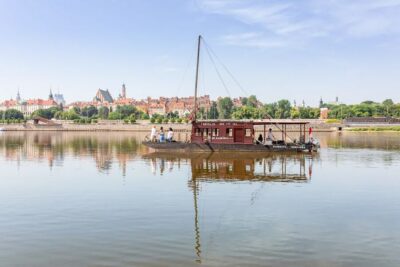
Traditional Galar Cruise on The Vistula River
Read our review →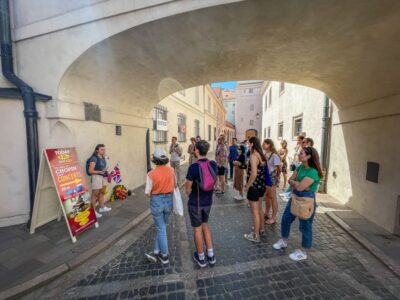
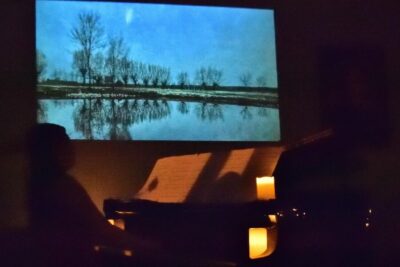
Warsaw Concert: Chopin – Painted by Candlelights with Wine
Read our review →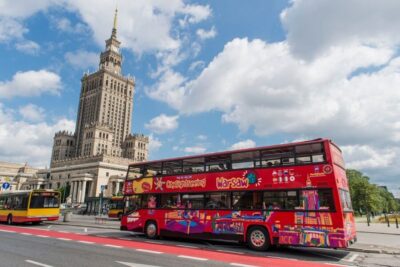
Highline Warsaw Entry With 360° Views & Rooftop Bar
Read our review →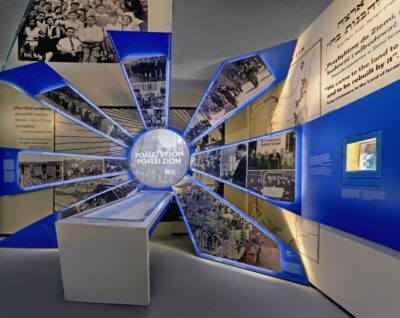
POLIN Museum of the History of Polish Jews Ticket
Read our review →
Browse the lists this tour appears in