
Review · NOWA HUTA & COMMUNISM TOURS
Communist Warsaw: private tour by retro minibus with hotel pickup
Warsaw’s communist story is written in concrete. This private 3 hour tour uses a retro minibus to connect the dots across landmarks and neighborhoods that still shape what you see today. You get easy hotel pickup and drop-off, plus a guide who turns buildings, statues, and streets into a clear timeline of Soviet-backed design and control.
I really like how the tour mixes big iconic architecture with street-level realities, so communism does not feel like abstract politics. I also love the no rushing pace, short stops you can actually absorb, and the fact you stay focused because it is just your group. One thing to keep in mind, the classic minibuses may not have air conditioning, and some do not have seat belts, though they are allowed for historic vehicles.
In This Review
- Key Highlights to Know Before You Go
- Why This Communist Warsaw Tour Clicks in a Retro Minibus
- Price and What You Actually Get in 3 Hours
- Palace of Culture and Science: Symbol First, Terrace Later
- Muranów: Socialist Neighborhood Planning on Old War Ruins
- Passing the Old Town Reconstruction and the Soviet-Linked Route
- Praga Polnoc: When Investment Lags, People Make Their Own System
- Śródmieście: Socialist Realism and the Government District Power Scene
- Comfort, Timing, and the Small Details That Matter
- Who This Tour Suits Best (And Who Might Want Something Different)
- Should You Book Communist Warsaw?
- FAQ
- How long is the Communist Warsaw private tour?
- Is hotel pickup and drop-off included?
- Do you visit the terrace at the Palace of Culture and Science?
- Is the tour guided in English?
- What is included in the price?
- Are there admission fees for the stops?
- Is the tour private?
- Is air conditioning available in the minibuses?
- Can I bring children?
Key Highlights to Know Before You Go
- Private group attention: Just your group, so your English-speaking guide can tailor answers as you go
- Retro minibus transport: Less walking between sites, more time for the story behind each place
- Hotel pickup and drop-off: Included, but it can add time from farther hotels
- No terrace stop at the Palace of Culture: You keep the focus on ground-level symbolism and context
- Architecture meets daily survival: You will see how state planning collided with life in Praga Polnoc
Why This Communist Warsaw Tour Clicks in a Retro Minibus
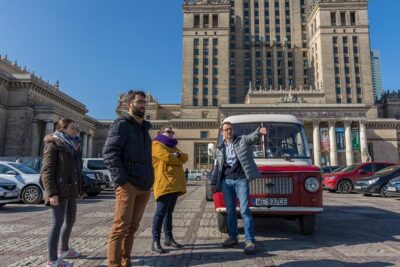
Warsaw can be done at a walking pace, but communism in this city is easiest to read when you move across districts. That is exactly why this tour uses a retro communist minibus. You are not bouncing between far apart stops on a tight schedule. Instead, you glide from one “statement” of power to the next, with short walks where you need them, and clear context where you do not.
The private format matters more than it sounds. When it is just your group, you are not competing with a crowd for explanations. If you care about why specific buildings look the way they do, or why certain neighborhoods were redesigned after the war, you get the kind of answers that make the city stop being a blur.
Also, the minibus setup is very practical. Each vehicle fits up to 8 passengers, and there is a fleet of minibuses available. That means the operator can keep things manageable even when more parties are booking. It is still a private tour for your group, but the logistics are set up to avoid chaos.
One more reality check: these are vintage vehicles. They come with heating for winter, but you should not expect air conditioning. If you travel in hot weather, dress with that in mind. Comfortable clothing and shoes help a lot because you will do some walking at each stop.
More Nowa Huta and communism tours:
- Private Tour: Warsaw’s Communist History by Retro Fiat
★ 5.0 · 115 reviews - Warsaw: Communism Tour in an Original Socialist Van
★ 4.5 · 35 reviews - Self-Drive Tour: Communist Warsaw by Retro Fiat “Toddler”
★ 5.0 · 23 reviews
Price and What You Actually Get in 3 Hours
At $134.43 per person for about 3 hours, this is not a budget grab. What makes it feel fair is the package. You get a professional English-speaking local guide, all fees and taxes, transport by retro minibus, and hotel pickup plus drop-off. For a short tour, that is a lot of value baked in.
You also get savings in the “hidden” category, planning effort. In places like Warsaw, the city layout can make it annoying to connect communist landmarks without extra transit time. Pickup removes that hassle. You do not have to figure out bus routes, ticket machines, or the safest walking paths between districts.
The other value point is private access. If you are traveling with family, a partner, or a small group, paying for a guided, chauffeured experience usually beats cobbling together multiple tickets and meetups. It is also a good choice if you want a structured overview rather than a free-form day where you might miss the political meaning of what you are seeing.
One note on timing: hotel transfer counts into the total tour time. If your hotel is far out, you may burn some of the 3 hours just getting to the first stop. If that is your situation, you might prefer meeting in the city centre, if the operator can arrange it.
Palace of Culture and Science: Symbol First, Terrace Later
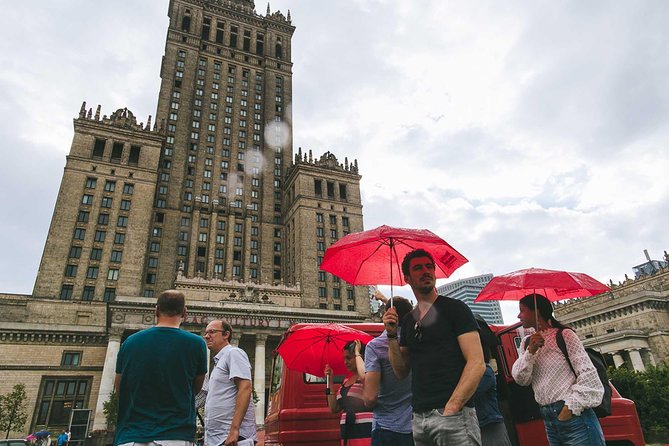
Your tour starts at the Palace of Culture and Science, Warsaw’s most recognizable communist-era landmark. Built in the early 1950s as a Soviet “gift,” it still dominates the skyline and still sparks debate. The building is controversial not because it is ugly, but because it represents a whole system: state power, cultural control, and architecture used as propaganda.
Here, the tour keeps things smart. You do not visit the terrace area high up. That is a real tradeoff decision. Skipping the terrace usually means less queue stress and more time to look at what matters at street level. You can focus on the facade, the monumentality, and how the building’s mass changes the city’s visual rhythm.
You will also get guidance on how locals read the place. This is one of those landmarks where your reaction might be instant, but your understanding comes after you learn the context. The guide’s job is to connect the building to the broader story of Soviet influence and postwar reconstruction, so it feels like more than just a photo spot.
The stop is short, around 20 minutes, and admission is listed as free. That makes it easy to fit into the schedule. Just be ready to look closely. Monuments like this reward people who pay attention, not people who are just trying to tick a box.
Muranów: Socialist Neighborhood Planning on Old War Ruins
Next comes Muranów, a district that makes an argument about reconstruction through design. Before World War II, Warsaw had a dense, older housing fabric. After 1945, communist authorities and modernist planners treated reconstruction as a chance to rebuild society. Muranów is one of the results, created in the late 1940s on wartime ruins with the goal of creating a model socialist neighborhood.
This stop is powerful because it moves the story from grand symbolism to daily space. You are not just seeing power, you are seeing how power shapes where people live. Streets, housing patterns, and the overall feel of the district give clues about what the planners wanted, order, collective living, and a visible break from the prewar city.
You will spend about 20 minutes here, with free admission listed. That is enough time to get oriented and understand the idea, especially with a guide pointing out what you might otherwise overlook. Muranów is one of those places where a quick walk with context can do more for your understanding than hours of wandering.
Potential drawback: because the stop is relatively brief, you will not get a deep “neighborhood study.” If you love urban history and want to linger, bring that energy for the post-tour moment and plan to walk around on your own afterward.
A few more Warsaw outings to weigh up
- Warsaw: Chopin Concert in the Old Town
★ 4.8 · 2,287 reviews - Warsaw: Traditional Galar Cruise on The Vistula River
★ 4.6 · 1,640 reviews - Warsaw: Old Town Highlights Walking Tour in English
★ 4.7 · 1,516 reviews - Warsaw Concert: Chopin – Painted by Candlelights with Wine
★ 4.8 · 1,442 reviews
Passing the Old Town Reconstruction and the Soviet-Linked Route
As the tour travels toward the Praga side of Warsaw, you pass through an area shaped by Old Town reconstruction and major infrastructure. The key idea here is that rebuilding was not only about restoring historic streets. It was also about building a functional traffic route with assistance from Soviet engineers involved in the Moscow metro.
That detail is a big deal for how you understand communism’s approach to cities. It was not just ideology. It was engineering, planning, and systems thinking, borrowed and adapted. When you see the way the city is laid out, it becomes easier to grasp how the new regime imagined mobility, control, and access.
This segment is mostly about perspective. You likely will not stop for a long time, but the passing views matter. If you pay attention to how districts connect and where big routes cut through, you start to see the city’s logic as something constructed, not accidental.
If you prefer tours with frequent photo stops, you might wish there were more time to step out at this stage. But the tradeoff is that the schedule keeps you moving toward the more emotionally charged parts of the communist story.
Praga Polnoc: When Investment Lags, People Make Their Own System
Praga Polnoc is where the tour shifts tone. This district offers a glimpse into the darker realities of communist Warsaw. State investment largely bypassed it, and that neglect helped create space for informal and illegal activity. Behind courtyards, people exchanged foreign currency, traded Western music, and searched for goods that were hard or impossible to find elsewhere.
I like this part because it treats history as lived experience. Ideology shows up in buildings, but it also shows up in scarcity. When official systems do not deliver, people adapt, sometimes quietly, sometimes through risk.
The stop lasts about 30 minutes, with free admission listed. That extra time helps because Praga Polnoc is not the kind of place where you can “get it” in two minutes. You need a little breathing room to understand the neighborhood feel and how the story connects to the broader communist system.
One practical consideration: Praga is often about small-scale street life and courtyards. Your comfort matters here, so wear shoes you can stand in for short walks and plan for weather. The minibus helps, but you will still do some walking.
Śródmieście: Socialist Realism and the Government District Power Scene
The tour ends in Śródmieście, the government district where you get a clear contrast. You see prewar modernist architecture next to monumental socialist realism, a visual clash that tells you a lot about the political battle for identity.
This is where the communist story feels most like a stage set. Big forms, heavy design language, and a sense of official dominance fill the area. The guide’s commentary helps you interpret what you are looking at, including the irony that the communist leader of Poland reportedly refused to move into the new party headquarters. The story goes that it looked more like a capitalist bank than an office for a workers’ party.
Even if you take that anecdote with a bit of skepticism, it captures the tension of the era. Communism wanted to project worker-led legitimacy, yet the architecture and power display were so grand and so “institutional” that the symbolism could flip in people’s eyes.
You get about 45 minutes here, the longest stop on the tour. That makes sense because you need time to process the mix of styles and meanings. You are also finishing in a zone that is useful for your next steps, since government district areas tend to be well connected for onward travel.
Comfort, Timing, and the Small Details That Matter
This tour is designed for people who want a guided structure without a long walking day. Transport handles most of the distance. Walking segments happen at each stop, so pack for that. Comfortable clothing and suitable footwear are the call, especially in winter when heating will be on but outside temps still matter.
For the vehicles, plan for vintage conditions. Some minibuses do not have seat belts, and air conditioning might not be available. Heating is included for winter season. If you are sensitive to heat, consider traveling in cooler months, or wear layers you can manage once you get inside.
You will also want to think about your meeting point. Pickup is included, but transfer time counts. If your hotel is far from the sights, you could end up with a shorter time on-site. If you want the full 3 hours to feel like a true tour, ask the operator whether meeting closer to the city centre would be better for your specific address.
Finally, it is delivered in English, and it is geared toward most travelers. The tour is private, meaning only your group participates. Each minibus fits up to 8 passengers, and the operator has a fleet of 5 minibuses available, which supports smooth handling across different group sizes.
Who This Tour Suits Best (And Who Might Want Something Different)
This tour fits you if you want a guided overview with meaning, not just a list of famous communist sites. It is especially good for:
- First-time visitors who want a coherent story in about 3 hours
- Travelers who care about how ideology shows up in architecture and urban planning
- Families or small groups who prefer hotel pickup and a private guide rather than public transit
It may not be your best match if you want long stops, deep museum time, or a lot of free wandering. The pacing is short and efficient. You get context, but you do not get hours in each place.
Also, if you are uncomfortable with vintage transport without air conditioning, that is a real consideration. You can still go, just prepare appropriately.
Should You Book Communist Warsaw?
I think this is a smart booking if you want your communist history in a format that is easy and understandable. Hotel pickup plus a private, English-speaking guide means you can spend your energy on seeing and learning, not figuring out logistics. The mix of the symbolic centerpiece, reconstructed urban space, and the lived reality of Praga Polnoc gives a balanced picture that feels grounded.
If you are the type who likes architecture, street-level history, and practical explanations, this tour is a strong choice. If you hate short stops or need lots of time for photos and lingering, you may feel a bit rushed.
My suggestion: book it if you want clarity fast, and treat the tour as the foundation for your later self-guided exploration. You will leave with enough understanding to notice the patterns Warsaw is using to tell its story.
FAQ
How long is the Communist Warsaw private tour?
The tour runs for about 3 hours.
Is hotel pickup and drop-off included?
Yes. Hotel pickup and drop-off are included.
Do you visit the terrace at the Palace of Culture and Science?
No. The tour does not include the XXXth floor terrace visit.
Is the tour guided in English?
Yes, it is offered with an English-speaking guide.
What is included in the price?
All fees and taxes are included, along with the professional English-speaking local guide and transport by retro communist minibus. Hotel pickup and drop-off are also included.
Are there admission fees for the stops?
The itinerary stops are listed as free admission.
Is the tour private?
Yes. It is a private tour or activity, and only your group participates.
Is air conditioning available in the minibuses?
Classic vintage minibuses are not equipped with air conditioning, but they have heating for the winter season.
Can I bring children?
Yes, most travelers can participate. For children under 150 cm, seat boosters are mandatory under Polish law, so you need to contact the tour operator in advance to check availability.
Fresh listings from Warsaw
- Wolf’s Lair & Treblinka Tour in 1 day from Warsaw★ 5.0 · 37 reviews
- Tour from Warsaw: Wolf’s Lair, Hitler’s HQ Zones I and II★ 5.0 · 32 reviews
- Wolf’s Lair Private Day Trip from Warsaw★ 5.0 · 50 reviews
- Warsaw’s Old Town A Self-Guided Audio Tour★ 4.5 · 10 reviews
- Wilanow Royal Palace : SMALL GROUP /inc. Pick-up/★ 4.5 · 16 reviews
- Private 3-, 5-, or 7-Hour Warsaw Tour by Car★ 5.0 · 7 reviews
- Off the Beaten Track in Warsaw: Private City Tour★ 4.5 · 9 reviews
- Warsaw Must-See Local City Tour with Antek and Tomek★ 5.0 · 51 reviews
Nowa Huta & Communism Tours, compared.
Legendary Private Nowa Huta Communism Tour with Crazy Guides
Read our review →
Nowa Huta: Steelworks Administration Buildings/Shelters Tour
Read our review →
Private Tour: Warsaw’s Communist History by Retro Fiat
Read our review →
Private Nowa Huta Adventure Tour in Communist Cars
Read our review →

Browse the lists this tour appears in