
Review · JEWISH HERITAGE TOURS
Warsaw Jewish Ghetto: private tour by retro car with hotel pickup
Warsaw remembers the ghetto where it happened. This private 3-hour tour strings key memorials and surviving streets into one clear route, with hotel pickup and a retro minibus that keeps you moving without wrestling transit. I love how the guide connects each stop to the 1943 Uprising and the deportations, and I love that you see what still physically remains, not just museum photos. The main drawback is that the subject is heavy and the mix of driving plus short walks can feel like a lot, especially since these classic minibuses may lack air conditioning.
You start at 10:00 am and can pick from a range of departure times when you book. You get a professional English speaking local guide, a mobile ticket, and a tight route that finishes at Umschlagplatz. One more thing I like, the stops build in stages: context first, then the ghetto boundary, then the uprising and its aftermath, and finally the deportation point.
In This Review
- Key highlights in plain language
- Why the retro minibus and hotel pickup matter in Warsaw
- Stop-by-stop: from Janusz Korczak to Umschlagplatz
- Stop 1: Monument to Janusz Korczak
- Stop 2: Grzybowski Square
- Stop 3: Próżna Street (Ulica Prozna)
- Stop 4: Fragment of Ghetto Wall
- Stop 5: Kamienica przy Waliców 14
- Stop 6: Chłodna Street
- Stop 7: Muranów
- Stop 8: Monument to Ghetto Heroes
- Stop 9: POLIN Museum area (outside view)
- Stop 10: Memorial at Mila 18
- Stop 11: Umschlagplatz
- The best parts are the physical survivals, not just the names
- Price and value: what $168.58 per person buys you
- Timing, walking, and what to wear on this route
- Who should book this private ghetto tour
- Should you book this retro-car Warsaw Jewish Ghetto tour?
- FAQ
- FAQ
- How long is the Warsaw Jewish Ghetto private tour by retro car?
- What time does the tour start?
- Is hotel pickup included?
- Is this tour private?
- What language is the tour in?
- Are museum or synagogue entrances included?
- Do the retro minibuses have air conditioning and seat belts?
- Can children join the tour?
- Are service animals allowed?
- What is the cancellation policy?
Key highlights in plain language
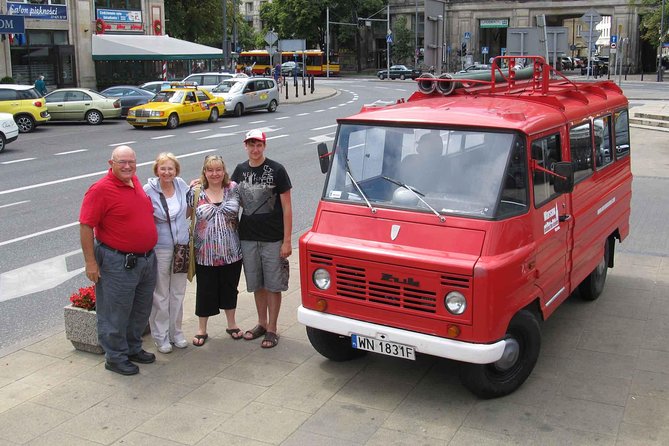
- Retro Communist-era minibus with pickup helps you avoid transit headaches and get straight to the sites
- Surviving street marks like Próżna Street and wall fragments make the ghetto’s footprint feel real
- Uprising focus at multiple sites including Mila 18 and the Monument to Ghetto Heroes
- Umschlagplatz as a hard ending so the story lands at the deportation point
- Optional museum time at POLIN Museum, so you can decide what fits your day
- Vintage-vehicle comfort limits: heating is provided, but some vehicles may not have air conditioning
Why the retro minibus and hotel pickup matter in Warsaw
Warsaw has a lot going on, but this route is specific, and it is not just sightseeing. The minibus format is useful because you are often moving between places that are meaningful for the story, not because they are close together in an easy, tourist-grid way. When you’re picked up within about 3 kilometers of the city center, you lose less time getting oriented.
It is also a privacy win. This is a private tour/activity, meaning only your group rides along. Each minibus holds up to 8 people, and there are multiple minibuses in the fleet, so the operator can keep things running even when the calendar is busy. The tour is often booked ahead (on average, about 23 days), so if your dates are fixed, I’d plan to lock it in early.
Comfort is a mixed bag, and it’s good to know that up front. These classic vintage minibuses are not equipped with air conditioning, and some do not have seat belts. The good news: heating is available in winter, and service animals are allowed. Still, if you are sensitive to cold, wear warm layers. You’ll be walking for short segments at each stop, then back onto a vehicle that may feel like a cool ride if the weather is harsh.
More Jewish Heritage Tours in Warsaw
- Warsaw: Warsaw Ghetto Private Walking Tour with Hotel Pickup
★ 4.9 · 369 reviews - Warsaw: Jewish History Guided Walking Tour in English
★ 4.7 · 324 reviews - Private Tour: Warsaw’s Jewish Heritage by Retro Fiat
★ 5.0 · 208 reviews
Stop-by-stop: from Janusz Korczak to Umschlagplatz
This tour is built like a guided route through the wartime geography of Warsaw, starting with human context and ending with deportation.
Stop 1: Monument to Janusz Korczak
You begin at the monument to Janusz Korczak, the Polish-Jewish educator, author, and director of a Warsaw orphanage. The key point here is moral and historical context: Korczak, despite the chance to escape, stayed with the children in his care and was deported with them to Treblinka.
This opening works because it keeps the tour from becoming only a list of sites. It sets a tone: people had names, choices, and consequences, and the ghetto story is not abstract.
Stop 2: Grzybowski Square
Next comes Grzybowski Square, an area that helps you understand what changed in Warsaw across the 20th century. It is a small stop, but it is there for a reason: this neighborhood has been reshaped by wars, totalitarian systems, and the rebuilding that followed.
You’ll also hear how nearby streets still preserve traces of pre-war Jewish life. That is a helpful mental exercise, because you start noticing the layers immediately, even when you are not standing in front of a major memorial.
More retro car rides in Warsaw:
- Private Tour: Warsaw City Sightseeing by Retro Fiat
★ 5.0 · 562 reviews - Private Historical Tour of Warsaw by a Retro Fiat with Pickup
★ 5.0 · 190 reviews - Warsaw Must-Sees: 4-Hour Private Tour by Retro Fiat
★ 4.9 · 123 reviews - Private Tour: Warsaw’s Communist History by Retro Fiat
★ 5.0 · 115 reviews
Stop 3: Próżna Street (Ulica Prozna)
Próżna Street is the only Warsaw street where pre-war Jewish tenement houses have survived. In other words, you are not just looking at a recreated idea. You are standing near surviving physical proof of what Warsaw’s Jewish community once built and lived in.
This stop also connects to living culture. The street becomes a focal point during the annual Singer’s Warsaw Jewish Culture Festival, which is a meaningful reminder that remembrance is not only about the past. It points to how communities keep their culture present.
Stop 4: Fragment of Ghetto Wall
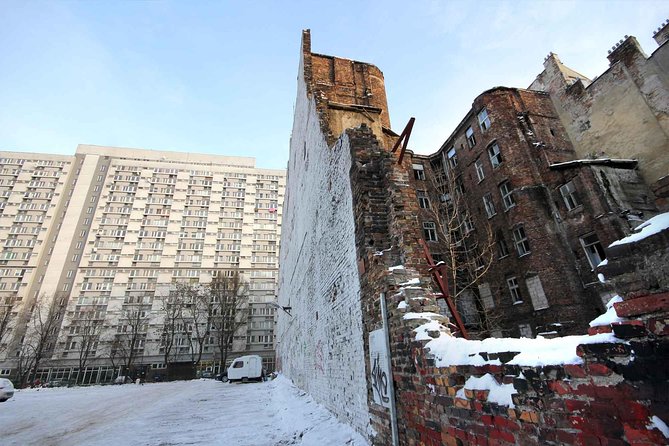
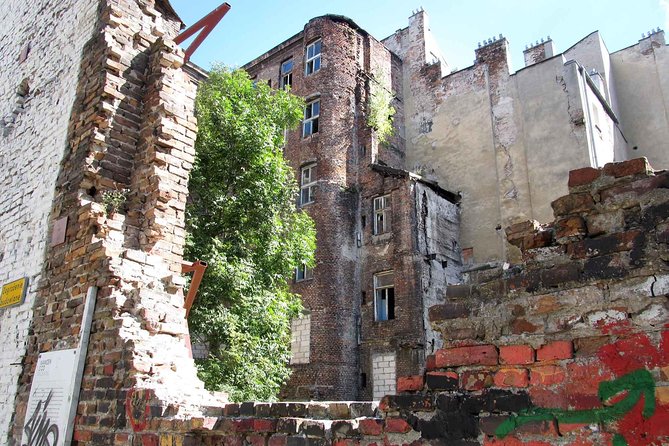
Then you reach a preserved fragment of the Warsaw Ghetto Wall, marking the former boundary of the ghetto. One of the most striking parts is that some sections were hidden between buildings. Your guide leads you to an accessible spot so you can understand how the boundary worked in real, everyday space.
This is where the tour shifts from background to mechanism. You start seeing the ghetto less as a line on a map and more as something that limited movement, controlled access, and reshaped daily life.
Stop 5: Kamienica przy Waliców 14
At Waliców Street, you’ll see a ruined tenement house often referred to as a last visible ghost of the ghetto. It includes a preserved fragment of the ghetto wall, which is emotionally heavy but also historically clear.
If you tend to prefer tangible details over general talk, this stop will likely land for you. Ruins can feel vague until a guide explains exactly what you are looking at, then suddenly the structure becomes readable.
Stop 6: Chłodna Street
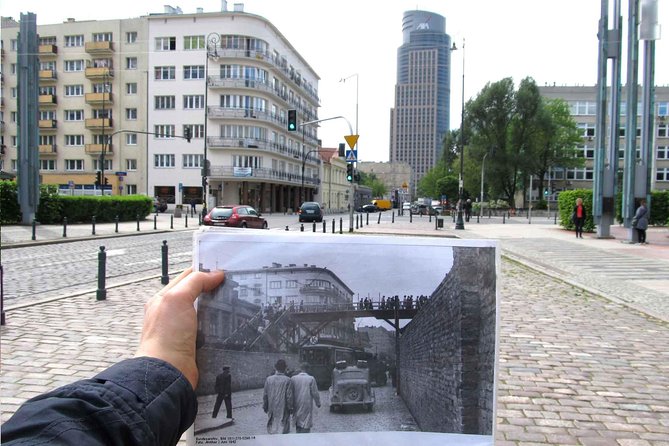
On Chłodna Street, you learn about a wooden bridge built in 1941 to connect the two separated parts of the ghetto. The tour provides the practical visual image: it rose above street traffic, with trams and German vehicles passing underneath.
Your guide uses archival photographs here, and that matters because the bridge is not the kind of thing you would guess from what you see today. It’s a reminder that the ghetto was engineered with control and separation, while daily urban life continued around it.
Stop 7: Muranów
Now you move into Muranów, the post-war residential district built on the rubble of the destroyed ghetto. At street level, it can look like a normal neighborhood, which is exactly why this stop is useful. Your guide explains how the ground beneath holds wartime layers.
This is a good moment to slow down in your mind. Instead of asking only, what buildings stand here now, you start thinking, what was erased, what survived, and what got built over it.
Stop 8: Monument to Ghetto Heroes
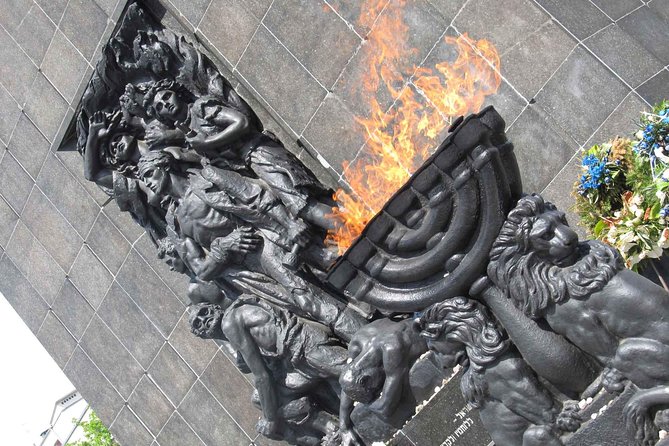
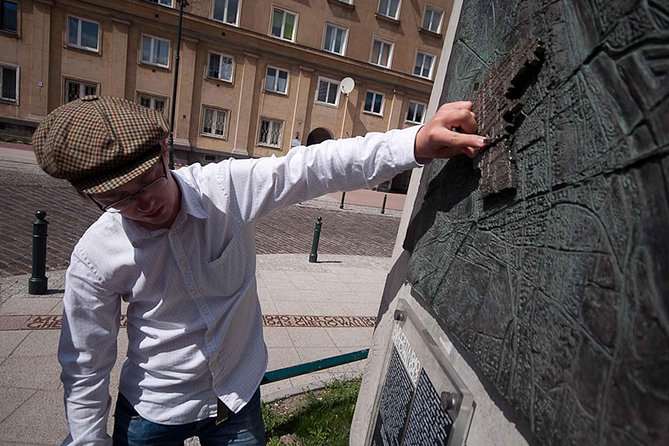
Then you come to the Monument to Ghetto Heroes, located near the site of the first armed clashes of the 1943 Warsaw Ghetto Uprising. The area also connects to remembrance and reconciliation events held over decades.
This is where the emotional arc changes. It is still solemn, but the tour gives you the fact pattern behind resistance, not just the headline. You’re reminded that uprising meant people were making choices under brutal conditions.
Stop 9: POLIN Museum area (outside view)
Next is POLIN Muzeum Historii Zydow Polskich, the museum built on the former ghetto grounds. The stop is outside, and entrance is optional and not included in the tour price.
This is a smart setup. You can keep your day moving if you want, or you can treat the museum as a separate, longer visit on another day. Also, the museum name has a legend connection to Jewish settlement in Poland, and your guide can give you that lead-in without forcing you into an immediate ticket purchase.
Stop 10: Memorial at Mila 18
At Mila 18, you learn about the bunker used by Jewish resistance fighters during the 1943 uprising. When German forces discovered the bunker, many who were hiding chose death rather than capture. The remains are buried beneath the memorial site.
This stop is short, but it hits hard. For me, the value is that it gives you a human-scale scene: hiding, discovery, and the final outcome. It also helps you understand why memorials here are not just historical markers, they are family-level tragedies turned into public memory.
Stop 11: Umschlagplatz
Finally, you end at Umschlagplatz, the former deportation point where Jews were transported to the Treblinka extermination camp. Today, the memorial at Stawki Street sits on that former function of the place.
It is a strong closing because the story moves from ghetto formation, to boundary and separation, to resistance, and then to deportation. You leave with the final chapter made concrete in your mind.
The best parts are the physical survivals, not just the names
A lot of history tours can feel like reading a script on the sidewalk. This route does better because you keep encountering physical anchors that make the story harder to dismiss as an idea.
- Próżna Street lets you stand near surviving pre-war tenements, so you can visualize continuity, not only destruction.
- Wall fragments show how the boundary existed in built space. You’re not only told about sealing off, you see where that sealing took form.
- The wooden bridge story adds a layer most visitors miss. It shows how the ghetto was connected and controlled at the same time, and how the city’s street life continued below.
- Muranów on rubble gives you the sense of modern Warsaw built on wartime ground.
- Mila 18 and Umschlagplatz move you from the geography of the ghetto to the facts of resistance and deportation.
There is also an important balance to watch. One concern that can come up with historical narration is how the tour frames Polish suffering and the role of different groups during the war. In one instance connected to this operator, Marcin Grabowski later clarified his intent, emphasizing that Nazi Germany murdered around 3 million Polish Jews and about 2 million Polish Catholics, and he also described covering both help and collaboration patterns during occupation. If you are very sensitive to phrasing, I’d recommend you ask your guide directly what themes they prioritize, especially around responsibility and victimhood framing, so you feel comfortable with the approach before the driving starts.
Price and value: what $168.58 per person buys you
At $168.58 per person for about 3 hours, this is not a budget-only experience. But it includes several things that would cost you separately if you tried to DIY.
You get:
- a professional English speaking local guide
- transport by a retro communist minibus
- hotel or apartment pickup and drop-off within a 3 km radius
- a setup where the route includes driving and walking so you can cover many key sites without planning connections
You also do not have to pay for every entry. POLIN Museum entrance is optional and not included, and synagogue and cemetery entrance fees are also not included if those visits happen. That means your money is mostly paying for the guidance and the transport, not a pile of ticketed add-ons.
If you compare it to taking trains and buses between scattered memorials, the value jumps. You are also saving mental energy: the guide handles the order, timing, and explanations, so you can focus on understanding what you’re seeing.
Timing, walking, and what to wear on this route
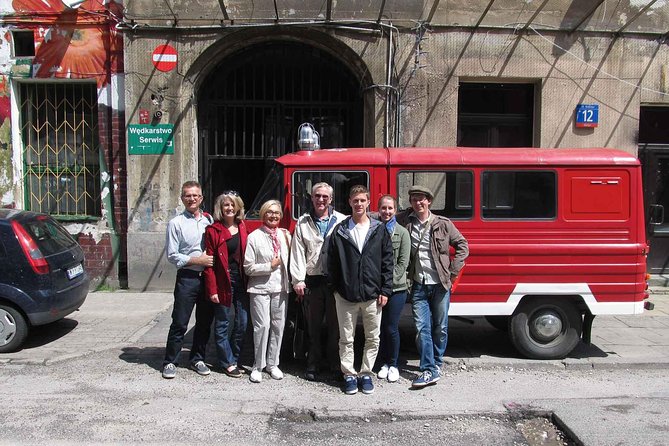
The tour runs roughly 3 hours, and there are wide departure times when booking is available. You start at 10:00 am for the listed start time, but other departure options exist, which helps if you want to pair this with other Warsaw stops the same day.
A detail that affects your day: pickup travel time counts toward the tour’s total time. Pickup is available within 3 km of the city center. If your lodging is farther or hard to reach by car, the operator will suggest the closest comfortable meeting point. If you want the full 3 hours focused on walking and explanations, meeting nearer the center can make sense.
For comfort:
- wear comfortable clothing and suitable footwear, because there are short walking segments
- dress for cold, since the vehicles are vintage and may have no air conditioning
- expect a quiet, reflective pacing, especially at Mila 18 and Umschlagplatz
Who should book this private ghetto tour
This works best if you want:
- an English guided route through multiple key ghetto and uprising landmarks
- a format that is efficient, covering many locations in a single half-day window
- a historical context first approach, starting with Janusz Korczak and then moving into the ghetto boundary and uprising sites
It may also be a good fit for families, with one caveat. Booking for children is stated as adult and children over 150 cm (4 ft 9 in). If you have a younger child, seat boosters are mandatory under Polish law, and you should contact the operator in advance to check availability.
If you’re short on time in Warsaw, this type of guided route often beats trying to stitch memorials together yourself. If you want the widest possible freedom, like lingering longer inside museums, you might also plan to add POLIN Museum later since museum entrance is optional and not included.
Should you book this retro-car Warsaw Jewish Ghetto tour?
Yes, I think it’s a strong booking for most visitors who want meaning, not just sightseeing. The route is practical, the pickup and retro minibus reduce friction, and the stop selection is built around real surviving traces, boundary remains, and the uprising and deportation story arc.
Book it if:
- you want a guided English explanation across Umschlagplatz, Mila 18, and ghetto wall fragments
- you appreciate seeing surviving street-level remnants like Próżna Street
- you want a private group setup that stays focused for about 3 hours
Think twice or ask questions first if:
- you are very particular about historical framing around collaboration and Polish suffering, so you can ensure the guide’s tone matches your expectations
- you dislike emotionally intense tours, because this route moves quickly through some of the harshest wartime realities in Warsaw
FAQ
FAQ
How long is the Warsaw Jewish Ghetto private tour by retro car?
It lasts about 3 hours.
What time does the tour start?
The start time listed is 10:00 am, with a wide range of departure times available when you book.
Is hotel pickup included?
Yes. Pickup and drop-off are included within a 3 km radius of the city center.
Is this tour private?
Yes. It is a private tour/activity, and only your group participates.
What language is the tour in?
The tour is offered with an English speaking local guide.
Are museum or synagogue entrances included?
POLIN Museum entrance is optional and not included. Entrance fees to synagogues and cemeteries are also not included (visits are optional).
Do the retro minibuses have air conditioning and seat belts?
Classic vintage minibuses are not equipped with air conditioning. Some vehicles do not have seat belts, which is permitted for historic vehicles. All vehicles have heating for winter.
Can children join the tour?
Adults and children over 150 cm (4 ft 9 in) can book. For children under 150 cm, seat boosters are mandatory under Polish law, so you should contact the operator in advance to check availability.
Are service animals allowed?
Yes, service animals are allowed.
What is the cancellation policy?
Free cancellation is available up to 24 hours in advance of the experience start time for a full refund.
More Jewish Heritage Walks in Warsaw
- Warsaw: Ghetto, Jewish Cemetery & POLIN Museum Private Tour
★ 4.8 · 132 reviews - Warsaw: Jewish Heritage & Holocaust Walking Tour
★ 4.7 · 119 reviews - Tour of the Warsaw Ghetto
★ 5.0 · 119 reviews - Jewish Warsaw Walking Tour
★ 5.0 · 95 reviews
Fresh listings from Warsaw
- Wolf’s Lair & Treblinka Tour in 1 day from Warsaw★ 5.0 · 37 reviews
- Tour from Warsaw: Wolf’s Lair, Hitler’s HQ Zones I and II★ 5.0 · 32 reviews
- Wolf’s Lair Private Day Trip from Warsaw★ 5.0 · 50 reviews
- Warsaw’s Old Town A Self-Guided Audio Tour★ 4.5 · 10 reviews
- Wilanow Royal Palace : SMALL GROUP /inc. Pick-up/★ 4.5 · 16 reviews
- Off the Beaten Track in Warsaw: Private City Tour★ 4.5 · 9 reviews
- Warsaw Must-See Local City Tour with Antek and Tomek★ 5.0 · 51 reviews
- Private 3-, 5-, or 7-Hour Warsaw Tour by Car★ 5.0 · 7 reviews
Jewish Heritage Tours, compared.
Bike Tour of Old Town, Jewish Quarter and the Ghetto
Read our review →
Kazimierz, Schindler’s Factory & Ghetto Guided Tour
Read our review →
Full Bike Tour – the Old Town, Jewish Qtr & the Ghetto NEW BIKES
Read our review →
Warsaw Ghetto Private Walking Tour with Hotel Pickup
Read our review →
Jewish Quarter and Ghetto Electric Golf Cart Tour
Read our review →Browse the lists this tour appears in