
Review · WALKING TOURS
Krakow: Plaszow Concentration Camp Guided Walking Tour
Plaszow is quiet, and that is the point. This 2-hour guided walk through Krakow uses the few remaining traces of the camp, from the Grey House to memorials, to teach how the Nazi system worked and why Oskar Schindler’s story is inseparable from this place. I love the reflection-first pacing, with time to stand, look, and think rather than speed through.
I also love how the guide explains the camp in clear, sensitive steps, naming what you are looking at and why it mattered, from the roll-call square to the areas tied to the Jewish cemeteries. One possible drawback is that Plaszow has open ground and limited physical remains, so it is not a site built for casual sightseeing. You will need to lean into the guided context.
In This Review
- Key takeaways before you go
- Plaszow camp in Krakow feels different because it is mostly open space
- The camp story, in plain facts, from 1942 onward
- What you will actually see on the walking route
- The Grey House and the camp’s key structures
- Ruins and what they reveal: the pre-burial hall
- Traces of the Jewish cemeteries where the camp began
- The roll-call square, built for control
- Paths and ground traces where gravestones were used
- How the guide explains the camp’s sections
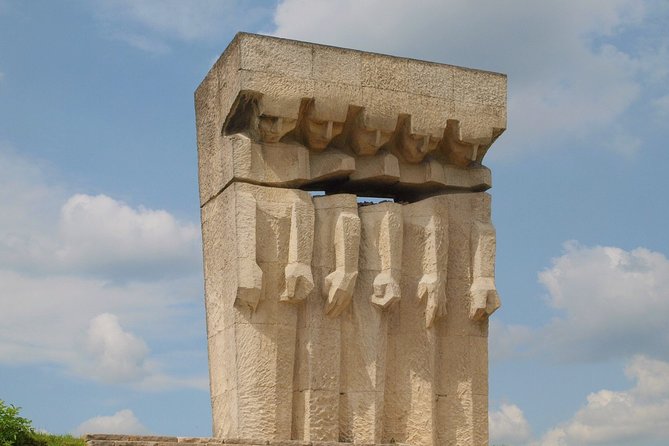
- Remembering at memorials like the Monument of Torn-Out Hearts
- Schindler’s connection: why it is part of the Plaszow story, not a separate add-on
- Why the guides get such strong praise
- Price and value: how $29 fits a serious two-hour experience
- Practicalities: meeting point, tram, and what to wear
- Who this tour is best for in Krakow
- Should you book the Plaszow Concentration Camp tour?
- FAQ
- Where is the meeting point?
- How long is the tour?
- How much does the tour cost?
- What is included in the price?
- What languages are available?
- Is the tour wheelchair accessible?
- Can I cancel for a refund?
- Is there reserve and pay later?
Key takeaways before you go
- A guided route through the main Plaszow sites like the roll-call square and the traces of the pre-burial hall
- Memorial time at places like the Monument of Torn-Out Hearts, designed for remembrance, not photos
- Schindler’s connection explained on the ground, including work permits and the later transfer to Brunnlitz
- Little-to-no “building sightseeing” because the camp is mostly open area, so your guide really matters
- Small-group feel in practice, with guides praised for answering questions with real depth (I’d plan to ask some)
Plaszow camp in Krakow feels different because it is mostly open space
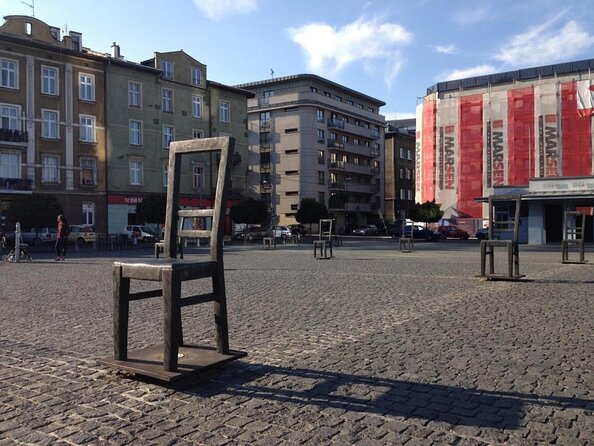
Most Holocaust sites people visit in Europe lean hard on preserved buildings. Plaszow does the opposite. Here, you are walking through open ground where the camp once organized lives, work, disease, administration, and forced labor. Today, you do not get big “look at that structure” moments. You get something harder, and honestly more powerful: space to remember.
That is why the tour’s pace matters. This is a route paced for reflection, not a sprint. You will stop at the spots that mark where events happened, including memorials that help you give shape to what is otherwise easy to overlook. The guiding style is built around understanding and respect, and you can feel it in how the walkthrough is paced.
And yes, it is also practical. The tour is only two hours. That means it fits neatly into a day without turning your entire trip into a somber marathon. It is also an excellent pairing if you are already planning time in Krakow’s Jewish quarter, since the camp story connects to what came before and what came after.
More Walking Tours in Krakow
- Old Town Krakow & Wawel Castle Walking Tour
★ 5.0 · 1,508 reviews - Creepy Krakow: 2-Hour City Walking Tour
★ 4.7 · 1,131 reviews - Krakow: The Old Town Walking Tour
★ 4.8 · 794 reviews
The camp story, in plain facts, from 1942 onward
Plaszow was created by Nazi German occupiers in October 1942 on the grounds of two Jewish cemeteries in Krakow. The camp did not start as a generic detention site. It began as a forced-labor camp for Jews from the liquidated Krakow ghetto.
Then the camp expanded its use. From July 1943, it also held Poles in a penal-labor section. In January 1944, it was redesignated as a concentration camp. Later in 1944, Plaszow also functioned as a transit camp for Hungarian Jews being sent onward to Auschwitz.
Numbers help you grasp the scale, even when the physical evidence is sparse. Over its existence, more than 35,000 people were imprisoned at Plaszow, and around 6,000 were murdered. Executions took place at several sites inside the camp, and today mass graves and memorials mark much of what you are meant to understand.
This is important context for your walk. Without it, the names of places you see on the ground can stay abstract. With the context, each stop becomes more specific, because you know what the Nazis were trying to do, how they organized control, and how violence unfolded step by step.
What you will actually see on the walking route
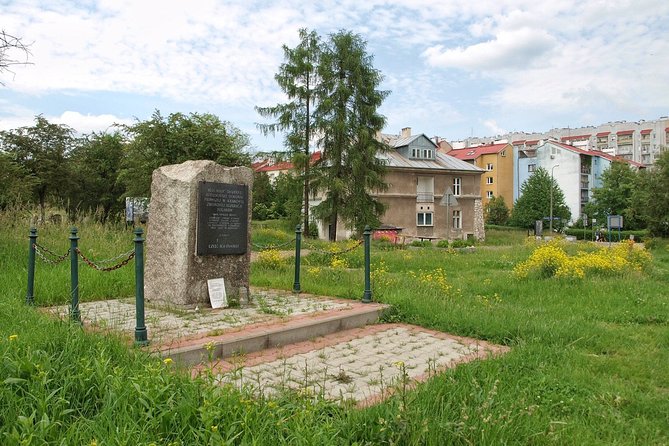
Plaszow is not a museum floor. It is a walk across the kinds of traces you only notice once someone helps you “read” them. Your expert guide pieces the camp together from what survives and what is now marked.
Here is the core route you can expect, and what each kind of stop is likely to mean during the tour:
The Grey House and the camp’s key structures
The Grey House is one of the anchor points of the tour. It helps frame the camp’s administrative and operational function, not just the idea of confinement. When your guide points to where structures stood, the explanation tends to connect daily life to the machine of control, so you understand what “camp organization” meant in real terms.
More memorial site visits:
- Guided Tour in Kraków-Płaszów Former Concentration Camp
★ 5.0 · 19 reviews - 2-Hour Guided Tour in Kraków-Płaszów Concentration Camp
★ 4.8 · 15 reviews - Krakow: Plaszow Concentration Camp Guided Walking Tour
★ 5.0 · 8 reviews - Guided Tour of Plaszow Concentration Camp, Kraków
★ 4.8 · 7 reviews
Ruins and what they reveal: the pre-burial hall
You will also see the ruins of the pre-burial hall area. Even when you are just looking at traces, these stops explain how bodies were managed and how death was processed within the camp system. It is not about shock. It is about clarity: how routine cruelty was turned into an organized workflow.
Traces of the Jewish cemeteries where the camp began
Plaszow began on the grounds of two Jewish cemeteries. That origin matters, and it shows up through what remains and through what the memorial landscape marks. This is a reminder that persecution did not just happen to people, it also tore apart places people lived with memory and identity.
The roll-call square, built for control
The roll-call square is often the moment when the tour becomes sharply concrete. A space like this was designed for visibility and discipline. Your guide uses it to help you understand why crowds were assembled, why order was enforced, and how daily survival was tied to constant supervision.
Paths and ground traces where gravestones were used
One especially chilling detail that your guide helps you grasp is the idea that fragments of gravestones were used to pave roads. It is one of those facts that can be easy to hear and then forget. On the walk, you see the kinds of paths where that history is tied in, and the explanation helps you connect destruction to something as mundane as walking space.
How the guide explains the camp’s sections
A major part of the value here is how the guide organizes the story into sections: living areas, hospital areas, administrative areas, and industrial parts. Even if you only catch parts at first, the framework gives you a mental map. After the tour, you are not just holding random facts. You have a shape for the place.
Remembering at memorials like the Monument of Torn-Out Hearts
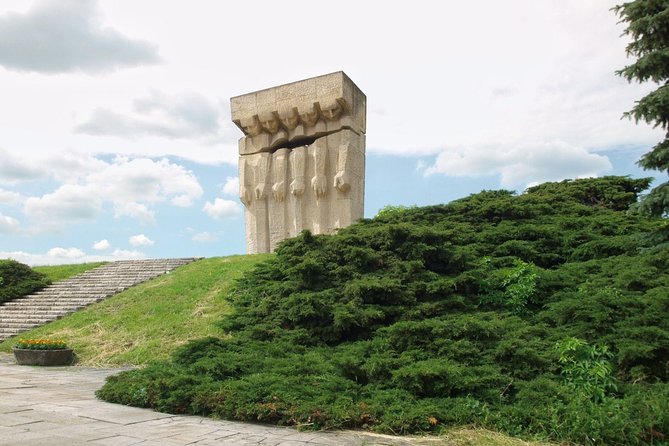
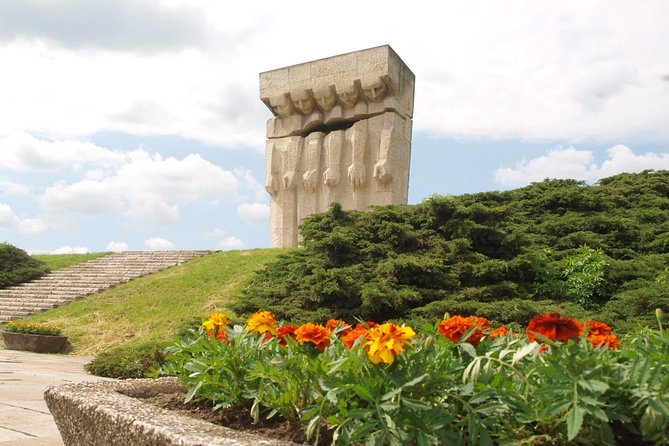
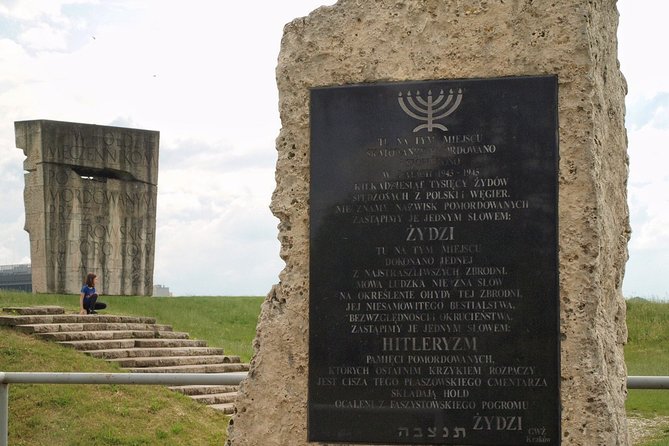
Plaszow is not built to be a photo loop. The memorial moments are built for remembrance. One key stop is the Monument of Torn-Out Hearts. This is where the tour leans into the emotional weight of what happened, and where the spacing of the walk encourages reflection.
What I like about memorial-focused tours is that they avoid the “checklist” feeling. Instead of rushing through, you stand at a marked point and your guide helps connect it back to the larger story of imprisonment, forced labor, and murder. The result is less like sightseeing and more like honoring.
And because the camp has fewer preserved structures, these memorial moments become especially important. They act like anchors for your attention. Without them, the open ground could blur into an empty park-like area. With them, the guide helps you see the history that is meant to be there.
Schindler’s connection: why it is part of the Plaszow story, not a separate add-on
In Krakow, people often associate Oskar Schindler with the famous narrative tied to saving lives. At Plaszow, his story is not treated as a side note. Your guide connects it directly to what the camp did and what it cost.
Here is the thread you will hear: Schindler used his enamelware enterprise to seek work permits for Jewish prisoners who were registered through Plaszow. In other words, Plaszow’s records and systems were part of the mechanism, and Schindler fought within that brutal reality to shield people from further transports.
Later, he organized their transfer to his wartime plant in Brunnlitz. That move saved over a thousand lives. Your tour helps you understand that this was not magic. It was paperwork, leverage, risk, and time, used in a context built to erase hope.
This matters because it gives you a counterpoint to the camp’s machinery. You still learn the organization of violence. But you also learn how someone tried to interrupt it using the tools available to him. The guide’s job is to keep those threads connected so the Schindler story does not float off into movie trivia.
Why the guides get such strong praise
When a site like Plaszow has limited physical remains, the guide is not just “nice to have.” The guide is what turns the walk into understanding.
Across the experiences shared, one theme stays consistent: guides are praised for being friendly, sensitive, and strong at explaining details clearly. Many people specifically note that guides answer questions with real depth. That is a big deal here because the camp’s structure is complex, and the open ground can feel confusing without context.
Names that come up include Anna and Dominika, as well as Krysztof and Phil, and guides like Barbara and Bartolomiew. People also appreciate that the guide can connect the camp story to other Krakow context, which can make the whole trip feel more coherent. One standout detail from the feedback is the sense that without a guide, Plaszow can be hard to interpret, since there is not much to “recognize” on your own.
I think that is exactly right. Plaszow is the kind of place where you want to ask, wait, and clarify. If you are the type who likes to understand how things worked, you will feel well served.
Price and value: how $29 fits a serious two-hour experience
At $29 per person for a two-hour guided tour, the value is about more than duration. You are paying for trained interpretation at a site that is intentionally quiet and mostly open area. Your guide helps you connect sparse remains to a documented timeline, major camp functions, and memorial points.
Also, you get a single tram ticket included, which is one less thing to sort out on the day. The meeting point is set, the route is structured, and the guide keeps the walking pace appropriate for reflection.
Could you do it independently with a guidebook? Maybe, but you would miss the camp’s organization and why specific traces matter. For me, $29 is a reasonable price to buy time and context, especially if you want this to feel respectful and not like wandering.
Practicalities: meeting point, tram, and what to wear
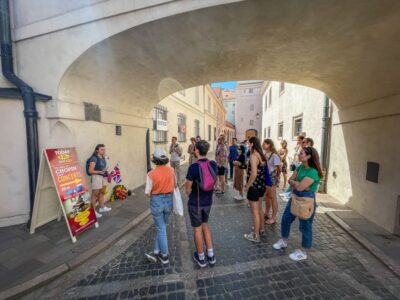
You meet in front of the entrance of Apteka Pod Orlem. Look for the guide with the excursions.city sign.
The tour includes a tram ticket, which helps you connect to the area without extra ticket juggling. The duration is two hours, so you can plan a later stop afterward without feeling like you have spent your whole day on one somber site.
One practical thing to plan for: Plaszow is outdoors. With limited structures, weather affects your comfort more than you might expect. Wear shoes you can walk in for a sustained two hours, and dress for conditions. This is also a good day to bring a small water bottle if it is warm, since you will be standing still at memorials.
The timing is also strict in a fair way. You are asked to arrive about 10 minutes early. Once the group departs, latecomers cannot join, and tickets cannot be refunded.
Who this tour is best for in Krakow
This is a strong pick if you want to understand Krakow’s WWII story beyond the headlines. It works especially well if you are already exploring the Jewish quarter first, because the camp story connects to what the Nazis did before, during, and after the ghetto liquidation.
It also suits history and WWII buffs who appreciate structure and detail. The tour’s organization into living, hospital, administrative, and industrial sections is exactly the kind of framework that helps you make sense of complex systems.
If you prefer preserved buildings and lots of physical photo backdrops, Plaszow might feel different. But if you like learning from what remains, and if you want a respectful, paced experience built around memory, this walk fits.
Should you book the Plaszow Concentration Camp tour?
If you are in Krakow for a short time and you want one guided experience that helps you understand how Plaszow worked, this is a good choice. The price is reasonable, the tour is only two hours, and the emphasis on reflection makes the visit feel appropriate.
Book it if you value a guide who explains what you are seeing and why it matters, especially in an area where the physical remains are limited. Skip it only if you are expecting a typical “site with lots of buildings to tour” or if you are not ready for an outdoor experience where the main work is thinking, remembering, and listening.
FAQ
Where is the meeting point?
Meet your guide in front of the entrance of Apteka Pod Orlem. Look for the guide with the excursions.city sign.
How long is the tour?
The tour lasts 2 hours.
How much does the tour cost?
The price is $29 per person.
What is included in the price?
You get an expert local guide, a 2-hour guided tour, and a single tram ticket.
What languages are available?
Live guides are available in Spanish, Italian, French, English, German, and Russian. The group tour runs in one language, based on what you choose when booking.
Is the tour wheelchair accessible?
Yes, the tour is wheelchair accessible.
Can I cancel for a refund?
Free cancellation is available up to 24 hours in advance for a full refund.
Is there reserve and pay later?
Yes, you can reserve now and pay later, keeping your plans flexible.
Fresh listings from Krakow
- Zakopane & Gubalowka Funicular – Private Winter Tour from Krakow★ 5.0 · 10 reviews
- ZALIPIE – painted village, unique PRIVATE tour from Krakow★ 5.0 · 20 reviews
- stag dog chase Krakow prank★ 5.0 · 4 reviews
- ZALIPIE – painted village, unique small group tour from Krakow★ 5.0 · 7 reviews
- Full-Day Zalipie Painted Village Guided Tour★ 4.0 · 3 reviews
- Sleigh Ride & Bonfire in Zakopane with Funicular – Private Trip★ 5.0 · 48 reviews
- Zakopane PRIVATE TOUR from Krakow★ 5.0 · 18 reviews
- Zakopane Funicular Hill & Thermal Springs regular tour★ 5.0 · 9 reviews
Walking Tours, compared.
Gdańsk City Sights & History Guided Walking Tour in English
Read our review →
Browse the lists this tour appears in